

























































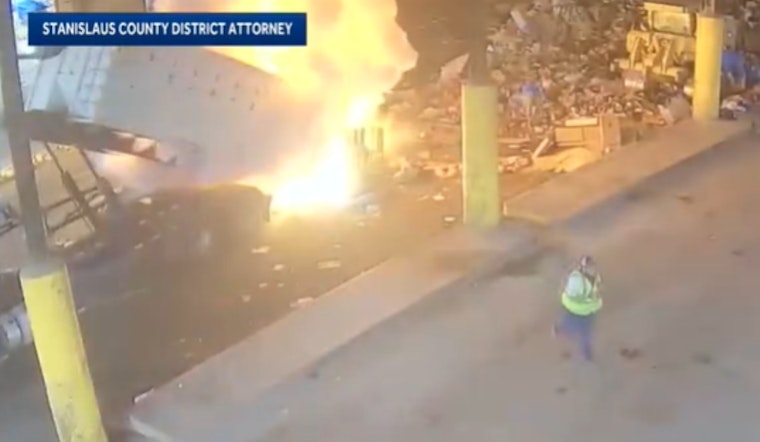
Stanislaus County prosecutors have charged two Modesto-area men in a chemical explosion case that rocked a local waste facility last spring. Yesterday, the district attorney’s office filed charges against Henry Meeks, owner of Riverbank-based Advanced Materials Manufacturing Technologies (AM2T), and AM2T manager Phillip Whitmore, tying them to a March 27, 2025 blast and fire at Gilton’s Resource Recovery Facility in Modesto. Whitmore is in custody, and an arrest warrant is out for Meeks as investigators retrace how 55-gallon drums of industrial material traveled from a Riverbank supplier to Gilton’s transfer yard.
What investigators say
According to CBS Sacramento, prosecutors say the trouble started as Gilton workers unloaded 55-gallon drums that held highly flammable powdered magnesium and aluminum. The load allegedly exploded and caught fire, injuring one Gilton employee and triggering the kind of industrial nightmare that firefighters train for but hope never to see. The district attorney’s office told reporters that crews initially tried to knock down the flames with water, which reacted with the metal powders, produced flammable hydrogen gas and set off a secondary explosion. Firefighters ultimately turned to heavy equipment and dirt to smother the blaze. Prosecutors say months of follow-up work, along with the review of video evidence, led to this week’s filing of criminal charges.
DA releases video and makes arrests
The Stanislaus County District Attorney’s Office publicly released dramatic video of the blast as it announced the case, and local coverage reports that the footage helped spur the move to file charges, according to KCRA. Investigators later found more 55-gallon drums that were allegedly being stored at AM2T’s Riverbank location. Whitmore was booked into jail, while Meeks remains wanted as authorities continue to sift through shipment records and paperwork tied to the movement of the drums.
Charges and potential penalties
Meeks and Whitmore now face allegations of illegal storage, transportation and disposal of hazardous waste under California’s hazardous-waste laws. State Health and Safety Code Section 25189.6 makes it a crime to knowingly or recklessly treat, handle, transport, dispose of or store hazardous waste in a way that creates an unreasonable risk of fire, explosion or serious injury. The statute allows prosecution as a misdemeanor or a felony and permits significant fines, per the state code. Local court records list presumptive bail amounts for related Health and Safety charges in Stanislaus County, a reminder that judges and lawmakers see these as more than minor regulatory slipups.
Why this matters for workers and firefighters
Prosecutors say Gilton workers were never warned that the drums they were handling contained combustible metal powders, a communication failure that sharply raised the danger level on the floor, KCRA reports. Powdered magnesium and aluminum can burn at extremely high temperatures and are known to react dangerously with water, which explains why firefighters had to abandon hoses and instead rely on heavy equipment and dirt to box in the flames. Gilton operates its transfer facility at 800 South McClure Road in Modesto, where industrial and municipal waste loads are brought in, sorted and moved along the disposal chain.
What comes next
The case now moves through Stanislaus County Superior Court, where prosecutors and investigators are still combing through records and video connected to the shipments. Whitmore remains in custody while the arrest warrant for Meeks is still outstanding, and officials say more enforcement actions or additional charges could follow if they uncover further violations. County leaders and safety officials point to the blast as a cautionary tale about what can happen when hazardous waste is mislabeled or mishandled, and why dull-sounding things like manifests and clear firm-to-facility communication can be the difference between a routine workday and a full-blown emergency.





