

























































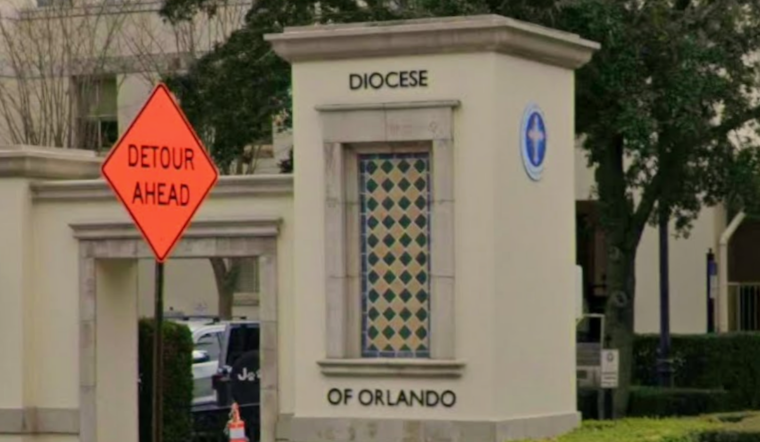
When Steven Langston walked into the Diocese of Orlando offices this week, he did not bring witnesses or paperwork to prove what he says happened to him as a child. He brought himself. Looking at a church lawyer, he said, “I am the evidence,” as he pushed the diocese to acknowledge abuse he says began when he was 7 and shaped the next four decades of his life.
Langston identified the priest he accuses and demanded the church accept responsibility for the trauma he says followed him for years. The tense exchange underscored a familiar collision in clergy abuse cases: survivors seeking recognition and institutions insisting they have followed internal rules.
What Langston says happened
In an interview and written communications described by the Orlando Sentinel, Langston said the abuse began when he was 7 and continued for about four years. He told the paper he identified the priest as Father Stephen McNicholas.
Langston told diocesan lawyers he wanted $10,000 for each of the 46 years he has lived with the fallout from the alleged abuse. According to the Orlando Sentinel, the diocese instead offered $10,000 to pay for a year of therapy.
The Sentinel also reported that Langston pleaded no contest in 2013 to five counts of dealing in stolen property, served about 24 months of a 28-month sentence, and was ordered to pay roughly $20,000 in restitution. According to the reporting, his later efforts to hire attorneys were complicated by Florida’s time limits on bringing older abuse claims.
Priest named is on the diocesan list
Father Stephen McNicholas appears on the Diocese of Orlando’s 2021 list of clergy the church has labeled “credibly accused,” according to ProPublica’s compilation of diocesan disclosures. That roster names about 20 people the diocese said were credibly accused, although the public entries generally offer few details about the specific allegations. McNicholas died in 2011.
Legal roadblocks for older claims
Florida lawmakers revised Section 95.11 and related provisions in 2010 in a way that narrowed civil options for many older abuse cases. The legislative chapter is part of the public record, and Florida legislative documents show that the amendment’s reach is limited in ways that have left some decades-old claims effectively time-barred.
Unlike a handful of other states that opened temporary “revival windows” for expired civil claims, Florida has not adopted such a broad look-back period. That legal landscape - combined with recent court interpretations - has made some attorneys wary of taking on older cases that may be blocked before they ever reach a jury.
Diocese response and recent court actions
The diocese told the Orlando Sentinel that it handled Langston’s report in line with diocesan policies. According to the diocese, victim-assistance staff reviewed available files but did not find records that supported his allegation.
The Orlando Sentinel also reported that in February, the diocese persuaded a judge to quash two highly publicized lawsuits related to clergy-abuse claims. Survivor advocates say those procedural victories further tighten an already narrow path to civil remedies. Diocesan spokespeople provided emails cited in the reporting but declined to offer additional comment for publication.
Why delayed disclosures happen
Researchers have long documented that many survivors of childhood sexual abuse do not disclose what happened until much later in life. Trauma responses, shame, dissociation, and community pressures can all delay both recognition of the abuse and any formal report.
A recent fact sheet from Child USA summarizes the academic work on delayed disclosure, noting that coming forward is often a process that unfolds over decades and that institutional settings can create additional obstacles. That research helps explain why some survivors who step forward years later focus on acknowledgment, access to records, or institutional change rather than solely on financial settlements.
What comes next
Langston says he plans to keep pressing the Diocese of Orlando for answers. Diocesan officials, for their part, say they have reviewed the materials he provided and offered counseling assistance.
Given Florida’s statute-of-limitations framework and recent court rulings that favor procedural defenses, civil options for older claims like Langston’s may remain limited. That reality leaves public scrutiny and demands for transparency as key tools for survivors and their advocates. They argue that Langston’s case highlights a broader fight over records, reform, and how powerful institutions respond when allegations surface decades after the alleged abuse.





