

























































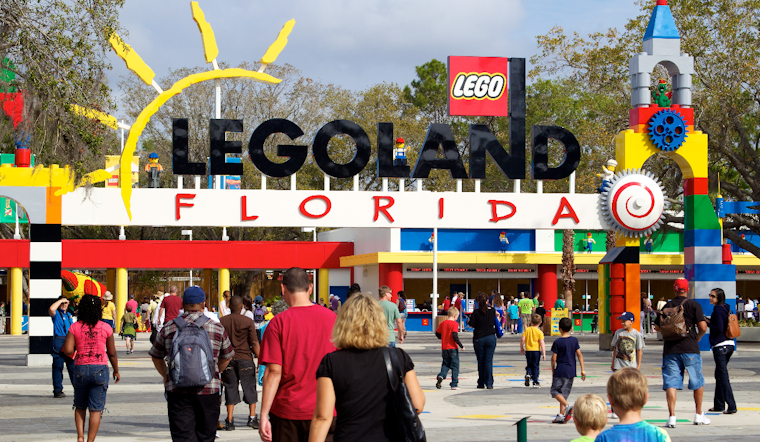
Legoland Florida's wooden Coastersaurus is set to reopen Sunday in Winter Haven after sitting closed since January for a refurbishment that touched everything from ground-level timber supports to the ride's braking and lap-bar systems. The coaster, billed as Florida's only fully wooden roller coaster, has survived hurricanes, bankruptcy sales, and multiple rebrands since it first opened in 2004, and park officials chose to restore it rather than replace it.
Cory Lytle, tech services director at Legoland Florida Resort, said Florida's humidity, termites, and other environmental conditions take a toll on wooden structures over time, a reality that shaped the scope of this year's work, according to the Orlando Sentinel. Lytle also called Coastersaurus one of the park's most popular rides, underscoring why Legoland opted for restoration over replacement. Per the Sentinel's reporting, the refurbishment focused heavily on the ground-level structural support of the coaster this year, building on an upper-half replacement the park completed in 2024.
What Actually Changed on the Ride
The coaster itself will look and run largely the same, since it retains the same course and its Lego-built dinosaur figures along the track. But the mechanical guts got real upgrades: a new motor for the train chain, an updated braking control system, a revamped operator interface, and a lap-bar monitoring system upgrade that Lytle said adds a layer of security. Lytle told the outlet that the new operating system also makes the transition back into the station less abrupt for riders.
Coastersaurus reaches speeds of about 32 mph and peaks at a 40-foot drop, with a ride lasting roughly 50 seconds across 1,365 feet of track, according to the Roller Coaster DataBase. The wooden structure itself uses premium pine treated to resist termites and mold, the same species-specific defense Lytle referenced when describing the demands of Florida's climate on the ride's timber. It's classified as a junior or family coaster, and riders must be at least 42 inches tall to board.
From Triple Hurricane to a Legoland Icon
Coastersaurus wasn't always a dinosaur-themed ride tucked inside a Lego-branded park. It debuted in 2004 as Triple Hurricane, built after the original Cypress Gardens botanical attraction closed, and the ride's construction and early operation were repeatedly delayed by Hurricanes Charley, Frances, and Jeanne that same year — a run of storms that also inspired its original name. The property itself has a tangled ownership history: in February 2004, Polk County purchased 30 acres of the botanical gardens while the Trust for Public Land secured state conservation easements, protecting the site from full residential development, according to Simple English Wikipedia. Adventure Parks Group then bought the remaining land to open Cypress Gardens Adventure Park later that year.
Merlin Entertainments eventually bought the park and rethemed the ride as Coastersaurus in 2011, as part of the site's transformation into Legoland Florida. Merlin had acquired the 150-acre Winter Haven property for $22 million in 2010 before officially opening Legoland Florida on October 15, 2011, according to FOX 13 Tampa Bay, with the company preserving the original 1936 Cypress Gardens botanical section while re-theming the rest of the amusement area. Manufactured by Quebec-based Martin & Vleminckx, the coaster originally ran with five-car Philadelphia Toboggan Coasters trains before switching to Great Coasters International Mini-llennium Flyer trains in November 2013, per the Roller Coaster Database.
A Rare History Among Wooden Coasters
Coastersaurus stands out for another reason: it's the only wooden roller coaster operating anywhere across Legoland's global network of theme parks, according to Ultimate Rollercoaster, since most Legoland properties elsewhere rely on steel or indoor dark rides built for younger children. The ride also has a documented safety history from its earlier days. In February 2006, a teenager fell from the ride after slipping out of his restraint. Still, state inspectors from the Florida Department of Agriculture found no mechanical deficiencies afterward, and park officials at the time said the lap restraint remained fully locked when the coaster returned to the station, the Tampa Bay Times reported.
That history sits within a broader regulatory framework that still governs the ride today. Under Florida Statute 616.242, the state's Department of Agriculture and Consumer Services conducts mandatory semi-annual safety inspections for permanent amusement rides at facilities with fewer than 1,000 employees, while larger parks use their own full-time inspectors instead, per the department's own guidance. In May 2023, Florida lawmakers also passed House Bill 1241, tightening inspection oversight and mandating employee training standards statewide, a shift the Florida Senate says followed increased legislative attention to attraction safety.
Part of a Bigger Legoland Buildout
Coastersaurus's return comes as Legoland Florida has been investing heavily elsewhere on the property. The park opened Galacticoaster, a modern indoor coaster spanning 1,500 feet of track across a 30,000-square-foot building, as part of a $90 million multi-park attraction expansion that Hoodline previously reported. The resort has also seen leadership change hands: former Busch Gardens Tampa Bay executive Brian Bacica was named park president of Legoland Florida Resort in late 2025, taking the reins during Coastersaurus's refurbishment.
Central Florida's coaster landscape has plenty of contrast to Coastersaurus's modest stats. Iron Gwazi, a hybrid coaster at Busch Gardens Tampa Bay, reaches 76 mph with a 206-foot drop, while other regional hybrids include White Lightning at Fun Spot near Orlando's International Drive and Mine Blower at Fun Spot Kissimmee. Coastersaurus's wooden lineage also connects to a stranger regional history: Boardwalk and Baseball in Haines City introduced the Florida Hurricane in 1978, also known as Michael Jackson's Thrill Coaster, before that park closed in early 1990. The ride was later relocated to Magic Springs theme park in Hot Springs, Arkansas, where it was known as the Arkansas Twister and operated until 2025; it's now listed as standing but not operating.
Winter Haven has also seen infrastructure investment near the park grounds. Polk County awarded a $1.9 million contract this month to build a new roundabout at Cypress Gardens Road and Lake Ned Road, a project Hoodline detailed earlier this month that's scheduled for completion in spring 2027. For now, the focus at Legoland is back on the wooden coaster itself, with the park set to welcome riders back to Coastersaurus this Sunday.





.jpg)