

























































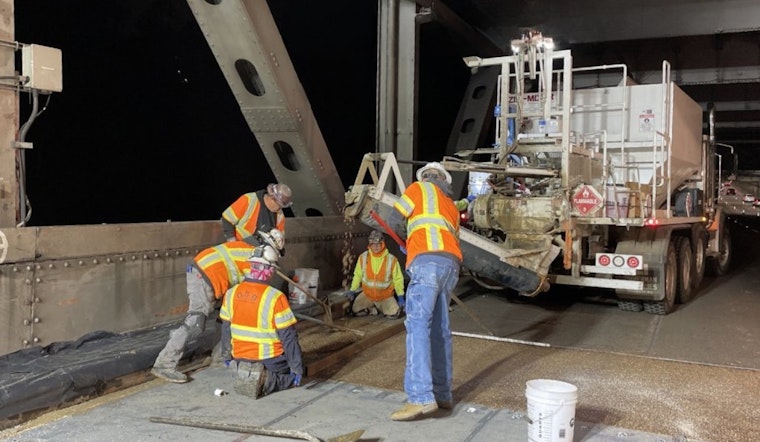
Bay Bridge regulars, brace for more late-night work overhead and underfoot. Caltrans says it has wrapped up Phase 2 of the San Francisco-Oakland Bay Bridge West Span expansion-joint rehabilitation and has now rolled into Phase 3, which started last Sunday. This stage focuses on removing temporary underdeck platforms and installing temporary deck plates on the bridge’s west end, a move that temporarily trims vertical clearance for vessels beneath the span. The night-time project, which began in August 2025, is scheduled to keep grinding along through June 2027.
Phase 3 details and schedule
Caltrans District 4 says Phase 2 ended after crews finished roughly two-thirds of the lower-deck reconstruction. Phase 3 began on Sunday with crews taking down the temporary underdeck platforms and placing temporary deck plates between towers W2 and W3 toward San Francisco, according to Caltrans District 4. The agency says those deck plates will stay in place through May while top-side repairs continue, mostly overnight, to avoid daytime traffic impacts. The full rehabilitation, which started in August 2025, is still slated to wrap in June 2027.
Maritime impacts and safety
Mariners are being told to plan ahead. The U.S. Coast Guard’s Local Notice to Mariners warns that the underdeck platforms reduce vertical clearance by about 2.8 feet, and equipment used during installation may temporarily lower clearance by as much as 15 feet. The notice also says a mid-span platform in Span C-D (W4-W5) will block the RACON Bravo signal while it is installed, and mariners are asked to transit with caution and contact the contractor or the Coast Guard Bridge Office for up-to-date conditions. The Local Notice to Mariners includes contractor contact information and precise navigation coordinates.
Why the work matters
The expansion-joint rehabilitation is part of a larger West Span Revitalization effort aimed at preserving the bridge’s lifespan, improving ride quality and boosting safety for the millions of vehicles that cross the span each month, according to the Metropolitan Transportation Commission. Officials say the finger-joint replacement and selective joint reconstruction address wear from decades of heavy use and help stave off more extensive, disruptive reconstruction work in the near future.
What to expect and where to get updates
Caltrans is asking motorists and mariners to check Caltrans QuickMap and 511 for real-time traffic and marine notices and to expect occasional nighttime lane restrictions while crews are on the job. For detailed schedules, maps and contractor contacts, see the Caltrans District 4 project page, which the agency says it will keep updating as each phase moves forward.





