

























































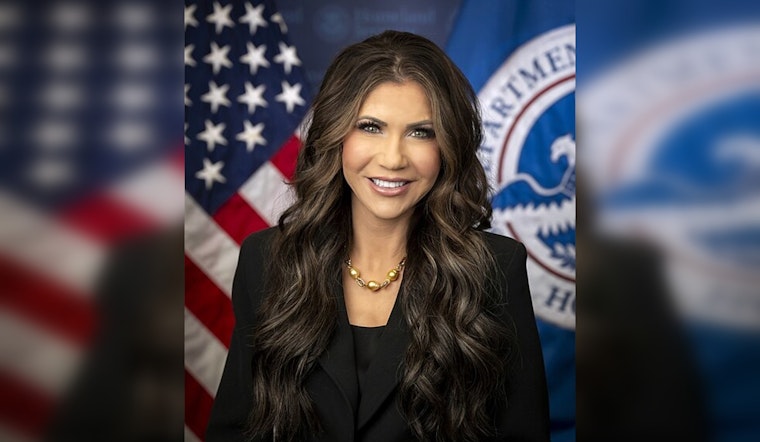
A 79-year-old New Port Richey man is headed to federal prison for a year after what started as political venting on social media turned into explicit threats against Homeland Security Secretary Kristi Noem and other federal officials, according to prosecutors. U.S. District Judge Charlene Honeywell handed down the sentence on Wednesday after the man admitted to transmitting threats across state lines.
The case, which prosecutors say began in early 2025, wrapped up with the one-year sentence announced this week, according to Tampa Free Press. The outlet identified the defendant as Benjamin Rubin of New Port Richey and reported that Judge Honeywell imposed the term following his guilty plea.
What He Posted
Court filings show Rubin's posts took a sharp turn in February 2025. On February 20, he wrote that the head of a federal law enforcement agency "will be assassinated." Two days later, he claimed he had "shot his TV" after seeing an ad featuring Kristi Noem and, according to prosecutors, warned that "the shots will be for her" if he encountered her in person. Prosecutors laid out those specific posts in a press release, according to the U.S. Attorney's Office.
Investigation and Prosecution
The investigation pulled in multiple agencies, including the United States Secret Service, the Federal Bureau of Investigation and the Pasco Sheriff's Office. Prosecutors say Special Assistant U.S. Attorney Joseph Wheeler III led the case. Rubin formally pleaded guilty in December 2025, according to Tampa Free Press.
Legal Implications
Under federal law, transmitting threats in interstate commerce is a crime. That conduct is covered by 18 U.S.C. § 875, according to Cornell Law School's LII. Rubin faced a maximum possible penalty of 10 years in prison, according to a press release from the U.S. Attorney's Office, although actual sentences depend on the federal guidelines and the number of counts charged.
Courts also have to navigate the Supreme Court's 2015 decision in Elonis v. United States, which underscored that prosecutors must show a defendant intended his words to be threatening. That ruling is summarized by Oyez.
The outcome in Rubin's case is a blunt reminder that violent online rhetoric can jump from a keyboard to a courtroom in a hurry. Local and federal authorities say they will continue to pursue what they deem credible threats against public officials, no matter where or how those threats are posted.





