

























































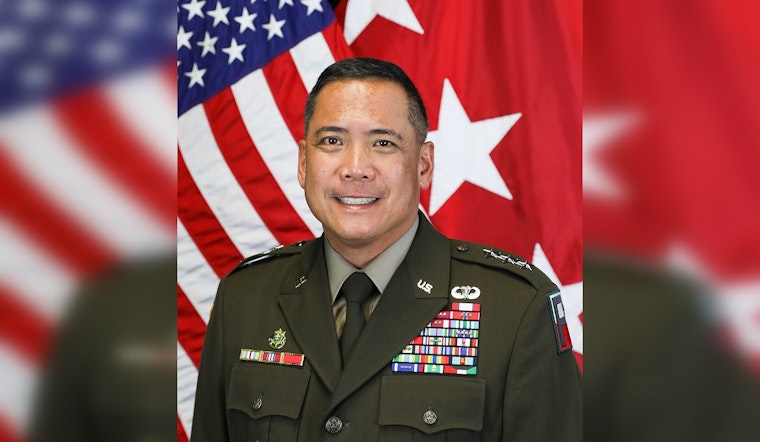
A Pentagon watchdog says the senior general once in charge of overseeing U.S. military aid to Ukraine left SECRET-level maps on a State Department-chartered train, then later suffered a concussion after what investigators described as heavy drinking at an official event in Kyiv.
The findings about Maj. Gen. Antonio A. Aguto Jr., the former commander of the Security Assistance Group-Ukraine, appear in a March 12 administrative investigation released this month by the Department of Defense inspector general.
According to a report by the Department of Defense Office of Inspector General, Aguto traveled with classified maps stored in a black cylindrical tube because they were too large to be double-wrapped or secured in a standard locked courier container. On the way back from a March-April 2024 rotation, the tube was left behind on a State Department-chartered train.
The lapse only came to light after the group realized the tube was missing. A Ukrainian train attendant later found it and delivered the maps to the U.S. Embassy in Kyiv about 24 hours after the loss was discovered, the report states. Investigators said more than 30 witnesses were interviewed and that the material did not appear to have been compromised, but they still tagged the incident as a serious breach of handling rules.
The same watchdog report also recounts a very different kind of trouble for Aguto: a May 13, 2024 dinner in Kyiv where he and others "drank from two bottles of chacha," a Georgian liquor the IG said runs roughly 40 to 50 percent alcohol. Aguto later fell in his hotel and was diagnosed with a concussion, as reported by Fox10 Phoenix.
Witnesses told investigators that the next day he showed up late and incoherent for a high-level meeting that included then-Secretary of State Antony Blinken and senior Ukrainian military officials. According to the report, the U.S. ambassador in Kyiv told investigators she worried at the time that Aguto might have been drugged.
The IG's account of his condition
The inspector general described Aguto as arriving for official events looking "disheveled," with bloodshot eyes, slowed speech and repetitive questions, symptoms investigators linked to his concussion. The report details multiple falls, including one outside the U.S. Embassy where he tore his jacket and hit his jaw.
Medical records cited in the investigation showed he was diagnosed with a moderate to severe concussion at a Kyiv hospital and later at Landstuhl Regional Medical Center in Germany. Aguto told investigators he had verbal approval from a senior officer to drink during the visit and pointed to medical issues and medications that can cause dizziness, but the IG concluded that any such verbal green light did not meet the formal waiver requirements laid out in policy.
Recommendations and fallout
The investigation kicked several allegations to other authorities for further review, including claims that Aguto discussed top secret information in public and accessed classified material while sheltering during an air raid. The watchdog also referred an allegation that he slapped someone at a private party to the Army Criminal Investigation Division, while declining to validate broader accusations of a toxic command climate.
According to The Daily Beast, the inspector general recommended that the Secretary of the Army take appropriate action on the misconduct it substantiated. The episode has become another test case for how the Pentagon handles both classified material and senior leader behavior in the middle of high-speed security assistance missions.
The report notes that Aguto led the Wiesbaden-based Security Assistance Group-Ukraine from late 2022 through August 2024 and is now retired. The Defense Department has forwarded the findings to Army leadership for possible personnel action. The investigation, formally released March 12, underscores the operational and reputational risks that can shadow high-profile missions in Europe. The Army did not immediately issue a public response to the IG's conclusions.



.jpg)