

























































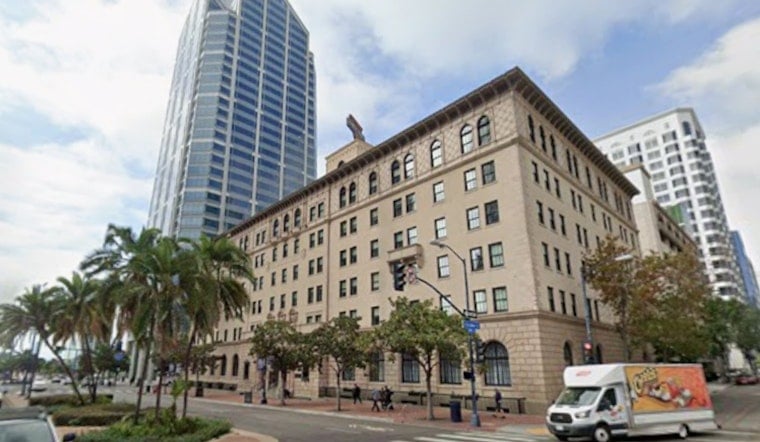
Some of San Diego County’s most recognizable buildings are getting some very friendly treatment from the taxman.
A snapshot released today shows that historic-property tax breaks under California’s Mills Act sliced roughly $29 million off property tax bills across the county. The county’s accounting shines a spotlight on a relatively small club of landmark conversions and upscale residences — downtown office towers and hotels, La Jolla condos, and Coronado beachfront homes — that captured the biggest reductions.
Top recipients and county totals
County assessor data puts total Mills Act savings at about $29 million. Among the heaviest hitters: the John D. Spreckels Building, normally assessed at roughly $138.5 million, is valued for tax purposes under the Mills Act at about $19.9 million. That gap works out to an estimated $1.2 million in yearly relief. The Guild Hotel’s contract delivers roughly a $696,585 annual tax benefit.
Other large write-downs include La Jolla properties and luxury condominiums that show six-figure to seven-figure yearly savings, according to an analysis from The San Diego Union-Tribune.
How the Mills Act works
The Mills Act, a state law passed in 1972, lets cities and counties strike 10-year contracts with owners of historically designated properties in exchange for reduced property taxes. Instead of relying on straight market comparisons, assessors use an income-based formula to calculate Mills Act values. For high-dollar landmarks, that alternative math can translate into steep percentage discounts.
The California Office of Historic Preservation outlines the statewide Mills Act framework, while the City of San Diego’s own Mills Act materials lay out which properties can qualify, when owners can apply each year, and how the city monitors buildings that are under contract.
Standouts in La Jolla, downtown and Coronado
Along the La Jolla coastline, Prospect Center at 1020 Prospect and the 464 Prospect condominium complex stand out in the county’s books. Prospect Center’s Mills Act break is listed at roughly $711,664, and 464 Prospect shows a sizable valuation gap that yields a six-figure annual tax cut.
Downtown, the Spreckels Building and the Guild Hotel rank among the largest commercial beneficiaries of the program. Across the bay in Coronado, roughly 200 Mills Act properties collectively account for a notable share of the countywide savings. Among them is Crown Manor at 1015 Ocean Blvd., a landmark residence that local historians note was built in 1902. The tax data on individual properties was compiled by The San Diego Union-Tribune, while the Coronado Historical Association documents Crown Manor’s local historic designation in its records.
Why officials and preservationists disagree
Backers of the Mills Act say those savings are supposed to be plowed back into restoration work, day-to-day maintenance, and seismic upgrades that keep older structures safe and standing. In their view, the program helps preserve neighborhood character without cities having to cut direct checks to property owners.
Critics see another side of the ledger. They argue that the Mills Act can operate as a hefty subsidy for owners of very valuable real estate, shifting costs onto the broader tax base. Some city staffers are already floating a package of preservation-rule changes that could affect how the program is administered.
Preservation groups emphasize how widely the Mills Act is used across the county, while county planning materials stress that the contracts come with enforcement teeth and penalties if owners do not deliver on required upkeep. For a deeper dive into the debate and the fine print, see reporting from KPBS, analysis from Save Our Heritage Organization, and the County of San Diego Historic Site Board’s enforcement details here.
Whatever reforms come next, the assessor’s snapshot makes one thing crystal clear: a preservation tool designed to protect historic buildings also moves meaningful sums off the standard tax rolls. How local leaders balance those fiscal tradeoffs against the public value of preserved landmarks will determine whether the Mills Act is treated primarily as a preservation lifeline or more and more as a contested tax break for prized properties.





