

























































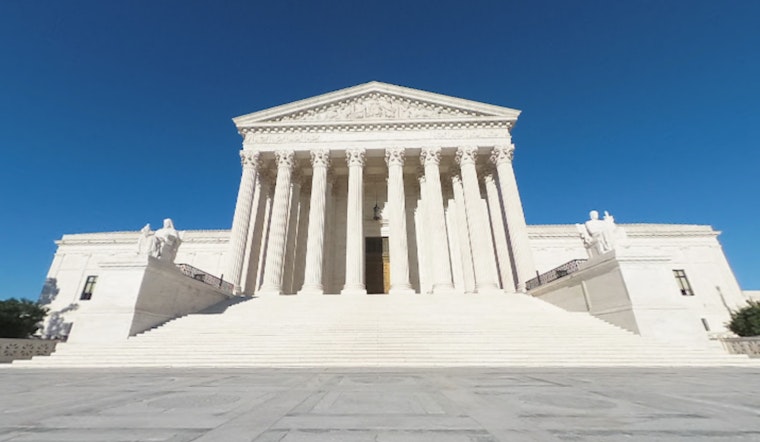
The U.S. Supreme Court is set this week to hear a Mississippi death-row appeal that accuses local prosecutors of systematically sidelining Black jurors and could reshape how courts police racial bias in jury selection. The case centers on Terry Pitchford, sentenced to death after a 2006 trial in Grenada County, and asks whether state courts unfairly decided he waived his right to challenge those jury strikes. With oral argument scheduled for Tuesday in Washington, the justices are staring at a familiar cast of players and a tense question about how far federal habeas law lets obvious discrimination go uncorrected, as reported by the Supreme Court docket.
Case lands at the high court
The court’s docket (No. 24-7351) shows the justices granted review on Dec. 15, 2025, and set oral argument for March 31, 2026, according to the Supreme Court docket. The narrow question the court agreed to hear is whether, under AEDPA’s deferential standard, the Mississippi Supreme Court “unreasonably determined” that Pitchford waived his right to rebut the prosecutor’s race-neutral explanations for striking prospective jurors.
What happened at trial
Jury selection in Grenada County began in February 2006 with a pool of 126 potential jurors: 40 Black, 84 white, one Hispanic and one person who did not report race. After cause challenges, the group shrank to 41, with just five Black prospective jurors left. Prosecutors then used peremptory strikes that produced a final panel of 14 jurors made up of 13 white jurors and one Black juror, a sequence laid out in U.S. District Judge Michael P. Mills’ 2023 memorandum granting relief in Pitchford’s habeas proceedings. Judge Mills’ opinion recounts how defense counsel objected to what they saw as a pattern of strikes and, the judge concluded, was not given a full chance to probe the prosecutor’s explanations.
How lower courts split
In 2023, Judge Mills determined that the trial judge had not adequately evaluated the prosecutor’s stated reasons for the strikes and ordered that Pitchford be released or retried. The U.S. Court of Appeals for the 5th Circuit later reversed that ruling, holding that AEDPA’s strict standard blocked federal habeas relief and that the state court’s finding of waiver could stand. The 5th Circuit opinion sets out the procedural dispute that now sits in front of the Supreme Court.
A familiar prosecutor in the cross hairs
Pitchford’s case features Doug Evans, the former district attorney who also prosecuted Curtis Flowers through six trials in a separate high-profile saga. In the Flowers decision, the Supreme Court criticized that prosecution’s history of jury strikes, writing that the state had engaged in a “relentless, determined effort to rid the jury of Black individuals.” That track record, along with data showing disproportionate strikes by Evans’ office, is central to Pitchford’s argument that courts should have taken a closer look at the trial record. The Flowers opinion and reporting by Mississippi Today describe the broader pattern Pitchford’s lawyers say was sidelined.
Who’s arguing and what they say
Joseph Perkovich of Phillips Black will argue for Pitchford. He told The Associated Press that the trial judge “did not grasp he had to a constitutional duty” to test the prosecutor’s explanations for the strikes. Mississippi Attorney General Lynn Fitch, in court filings, has defended the state Supreme Court’s decision and maintained that prosecutor Doug Evans did not improperly strike Black jurors, a position reflected in the state’s briefs and the materials on the court’s docket.
What to watch at argument
The justices are expected to dig into whether the Mississippi court’s waiver ruling was an “unreasonable application” of Batson under 28 U.S.C. § 2254(d), the key AEDPA provision that limits when federal courts may overturn state judgments. If the Court narrows the path to relief under AEDPA, federal judges could be more constrained in correcting state-court errors even when patterns of racial strikes appear, a risk the 5th Circuit emphasized and advocates have warned about. Both the 5th Circuit and the Death Penalty Information Center note that whatever the justices decide could affect other Mississippi capital cases.
What comes next
Oral argument is set for March 31, 2026, with a decision expected later in the term or by summer, depending on the Court’s schedule and internal deliberations. However the ruling comes out, Pitchford’s case is poised to send a clear signal about how the justices balance AEDPA’s limits on federal review against the need to police racial bias in jury selection, a question with immediate consequences for defendants, prosecutors and courts in Mississippi and beyond. Initial reporting on the case appeared at outlets including WKMG/ClickOrlando and has since been followed by additional national coverage and court filings.


