

























































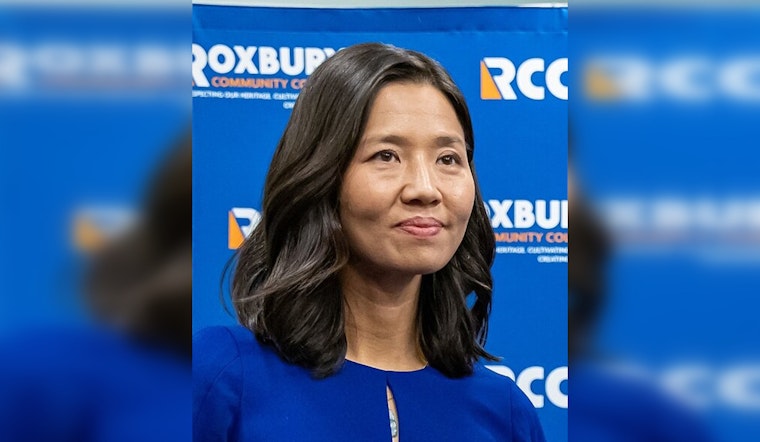
Boston is getting serious about artificial intelligence in the classroom, and Mayor Michelle Wu is putting tech heavyweights front and center to prove it. On Thursday morning at the Eliot Upper School in the North End, Wu is set to roll out a new public-private partnership that City Hall says is designed to make Boston Public Schools a national leader in K-12 AI literacy. The goal is for students to graduate with hands-on AI skills and a clear handle on how to use the technology ethically. Boston Public Schools Superintendent Mary Skipper and tech entrepreneur Paul English are expected to join Wu for the 10:30 a.m. announcement, as per NBC Boston.
Wu’s office is pitching the move as an attempt to put Boston at the front of the national pack. As NBC Boston reported, City Hall framed the effort as positioning Boston to be “the first major U.S. city to ensure that all of its public school students graduate with AI proficiency.” The outlet notes that Skipper and English are among those appearing with Wu at the Eliot Upper School, and that officials had not released full program details ahead of the event. According to the station, the district and its private partners plan to lay out how AI will be woven into classroom curriculum and how teachers will be trained to use it.
How This Fits Into Statewide AI Efforts
Boston’s play comes as Massachusetts is already moving to scale up AI skills for residents and educators. Governor Maura Healey recently announced a partnership with Grow with Google to open up AI training opportunities across the state, according to Mass.gov. The state has also launched school-focused efforts, including “Future Ready: AI in the Classroom,” a program aimed at giving teachers practical guidance on responsible, classroom-ready AI use, per Mass.gov. City officials say those statewide pilots offer a starting blueprint that Boston will adapt for its own classrooms and professional development sessions.
What AI Literacy Could Look Like in Classrooms
Educators and tech experts tend to agree that real AI literacy is about more than cranking out code. It typically includes how to write effective prompts, how to fact check and critique AI-generated answers, and how to understand issues like bias, privacy and responsible use. National coverage of early district pilots has stressed that none of that lands without serious teacher training, so professional development is expected to be a central piece of Boston’s plan.
Students, for their part, are not waiting for formal lesson plans. A report from Common Sense Media found that roughly seven in ten U.S. teens had already experimented with generative AI tools, often in schools where official policies were still a work in progress. Advocates argue that this gap between student use and school rules is one reason districts are scrambling to catch up. As Education Week and others have noted, many teachers see instructional upside in AI tools, but districts are still sketching out training plans and safety guidelines to make sure those tools are used in a way that benefits students.
Why the North End Backdrop Matters
City Hall chose its stage carefully. The announcement is taking place at the Eliot K-8 Innovation Upper School at 585 Commercial Street, a North End campus that highlights robotics and engineering labs among its offerings, according to the Eliot K-8 Innovation School. City documents describe the building as a hub for hands-on, tech-forward instruction and note that it was renovated to support collaborative STEM spaces, per Boston.gov. Using Eliot as the launchpad signals that officials are thinking about AI not just as a set of apps on student laptops, but as something that can be folded into project-based work in labs and makerspaces.
Local educators say the setting also gives the city a concrete example of where students could eventually apply AI concepts in real projects, from robotics builds to engineering challenges, rather than treating AI as an abstract topic that lives only in a textbook or on a slide deck.
What to Watch Next
For now, the broad strokes are clear and the fine print is coming. Officials say more details on funding, curriculum standards, teacher training timelines and student privacy protections will roll out as the district and its private partners lock in their agreement. NBC Boston carried Wu’s remarks and reported that the mayor’s office is framing the initiative as a multi-partner collaboration between the school system and outside stakeholders.
Among those stakeholders is Paul English, a Boston tech entrepreneur and philanthropist best known as a co-founder of Kayak, according to Wikipedia. His presence is a sign that City Hall is banking on private-sector backing to help build out curriculum, internships and training tied to AI. Watch for detailed documents from the mayor’s office and Boston Public Schools in the coming days that spell out who is paying for what, how quickly classrooms are expected to change and how the city plans to keep student data safe while it brings AI into the school day.





.jpg)