

























































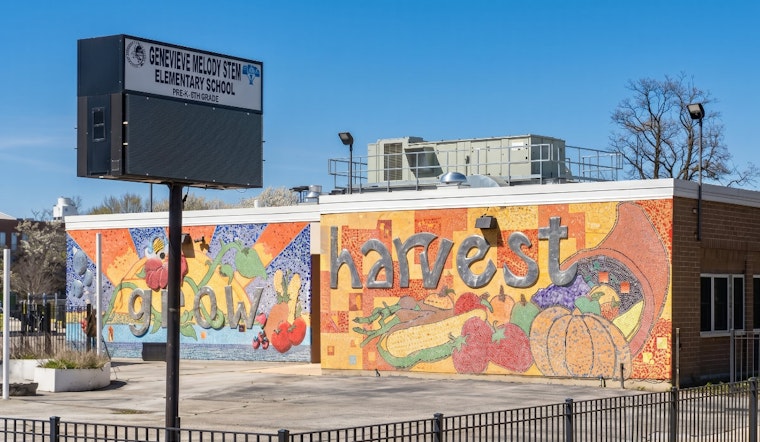
Two facilities within the Genevieve Melody STEM Elementary School complex in West Garfield Park both failed routine food inspections on April 20, 2026 — the same day — with inspectors from the Chicago Department of Public Health documenting more than 30 mouse droppings at each location. The dual failures at a school that serves some of Chicago's most economically vulnerable children raise immediate food safety concerns and echo a long, troubling history of rodent problems in Chicago Public Schools facilities on the city's West and South sides.
What Inspectors Found: Main Campus
At the Melody STEM Elementary at Delano Campus, 3937 W. Wilcox St., inspectors cited six separate violations. The most serious was a Priority Foundation violation under Chicago Municipal Code 7-38-020(A) for vermin contamination: over 30 mouse droppings were found scattered on the floor along walls beneath shelving units in the dry storage area, on the floor in a corner under a drainboard near the scrape sink, on the floor along walls behind the ice machine, and on electrical outlets behind cooking equipment. Management was instructed to call an exterminator immediately, and to clean and sanitize all affected areas.
Beyond the rodent issue, inspectors found timed faucets not functioning properly in kindergarten washrooms — water must run continuously for at least 15 seconds before the faucet reactivates under health code. A handwashing sink in the lunchroom staff washroom was slowly draining; the left faucet on the girls' third floor washroom was loose; and the right handwashing sink on the same floor was inoperable. Dust buildup was observed on light fixtures and wiring throughout prep and serving areas. The walk-in cooler had no functioning light. The inspection result was a Fail.
What Inspectors Found: CPC Campus
A few hundred feet away at the Melody CPC facility, 3905 W. Wilcox St., inspectors documented a nearly identical rodent violation: again, over 30 mouse droppings scattered along walls behind shelving and a refrigerator in the teachers lounge, and inside a cabinet under the sink in the parent room — both non-food-preparation areas, but within the same building complex and indicative of a broader infestation. That facility was also cited for low water pressure at the left faucet of the three-compartment sink, low hot water pressure at handwashing sinks in the washrooms, and an active leak under the sink in the parent room. That inspection was also a Fail.
The fact that both facilities failed on the same day, with near-identical rodent findings, suggests the mouse activity is not isolated to a single room or corner but reflects a building-wide or campus-wide infestation requiring comprehensive treatment — not just a spot clean and trap placement.
About the School and Its Community
Genevieve Melody STEM Elementary serves approximately 322 students in grades pre-K through 8 on its main West Wilcox campus, according to Chicago Public Schools. The school is led by Principal Tiffany Tillman and is one of the district's magnet STEM programs, offering before-school music and sports enrichment alongside its academics. The student body is 98% economically disadvantaged, according to U.S. News & World Report — a figure that underscores how essential the school meal program is here. These are children who may depend on what is served in that cafeteria for their most reliable daily nutrition.
The school sits in the West Garfield Park neighborhood on Chicago's West Side, a community that according to Illinois Policy Institute analysis of 2024 Census data, is among the highest-poverty areas in the city, with the adjacent East Garfield Park reporting that three-quarters of residents in some census tract clusters live below the poverty line. The neighborhood is overwhelmingly Black. As documented repeatedly over the years, rodent infestation problems in CPS schools have been disproportionately concentrated in schools serving low-income communities of color on the West and South sides.
A Deeply Rooted Problem in CPS
Monday's dual failures are not an anomaly — they are part of a pattern with deep roots. As the Chicago Sun-Times revealed in an extensive investigation, a CPS-ordered inspection "blitz" following a high-profile rodent infestation at Mollison Elementary found that of 125 schools inspected, only 34 passed — and CPS quietly halted the inspections before finishing all 220 planned schools, shortly after the Sun-Times requested data. The problems found included rodent droppings, filthy food-preparation equipment, and bathrooms lacking hot water. The pattern, the Sun-Times noted, mapped closely onto the district's most underserved campuses.
That history includes a particularly grim episode documented by CBS Chicago: at Hirsch Metro High School, mice accessed nachos in the school kitchen, and multiple students became sick after consuming food contaminated with rodent droppings. CPS has an official Integrated Pest Management policy mandating the use of preventive structural controls and routine inspection and monitoring to minimize pest presence — but policy and practice, as these repeated failures demonstrate, are not always the same thing.
What Comes Next
A failed canvass inspection in Chicago does not automatically result in closure, but it does trigger required corrective action and a follow-up reinspection. For the rodent violation specifically, management was directed to contact a licensed exterminator, clean, and sanitize all affected areas before reinspection. Given that the droppings were found adjacent to dry storage, near the scrape sink, and behind cooking equipment — all areas in the food preparation and service pathway — the urgency of compliance cannot be overstated.
CPS is the permit holder responsible for maintaining these facilities. Hoodline has reached out to Chicago Public Schools and to the CDPH Food Protection Division for comment and will update this story when responses are received. The CDPH Food Protection Division can be reached at (312) 746-8030. Parents and community members can look up current inspection records for any Chicago food facility through the City of Chicago open data portal.





