

























































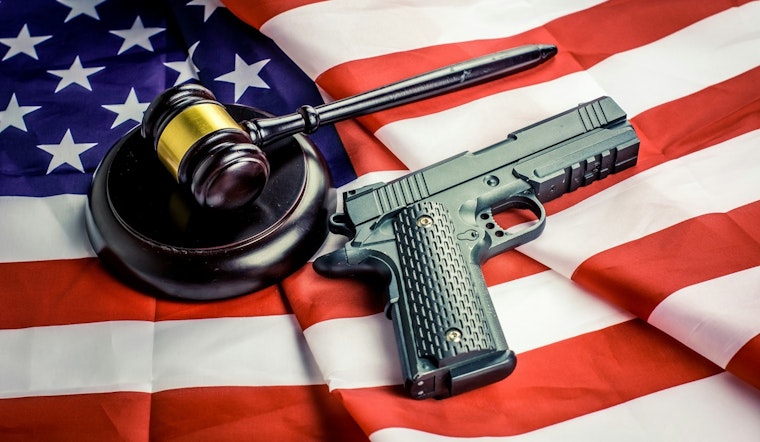
In a case that has civil libertarians, libertarians and gun-rights activists suddenly on the same side, three very different advocacy groups are backing a challenge to North Carolina’s felony gun-possession law at the state’s highest court.
The American Civil Liberties Union of North Carolina, the libertarian Cato Institute and gun-rights group Grass Roots North Carolina have all filed briefs arguing that the state’s blanket ban on firearm possession by anyone with a felony record goes too far. Their filings land as the appeal of Eric James Ducker, a Buncombe County man convicted after police say they found a handgun on his hip, moves through the courts. The outcome could reshape how judges treat old or nonviolent convictions that currently strip people of the right to bear arms for life.
Why the Briefs Matter
According to the amicus brief filed by the ACLU of North Carolina and the Cato Institute, N.C. Gen. Stat. § 14-415.1 disarms people solely because they have any felony conviction, without asking whether the crime was violent or how much time has passed. The brief urges the North Carolina Supreme Court to apply the U.S. Supreme Court’s post-Bruen framework in a way that allows individualized, history-based review instead of a one-size-fits-all prohibition.
The News & Observer has reported on the unusual coalition that has formed around the challenge to the law.
The Ducker Case
As laid out in the North Carolina Court of Appeals opinion, a Buncombe County jury in August 2023 found Eric James Ducker guilty of possessing a firearm as a felon after officers said they discovered a handgun in a hip holster during a traffic stop. The opinion notes that Ducker pleaded guilty in 2009 to attempting to flee to elude arrest and was convicted in 2018 of violating a domestic violence protective order.
Ducker had asked the trial court to dismiss the indictment before trial, but that request was denied. The Court of Appeals later upheld his conviction in a published decision.
A Rare Coalition
What makes the case stand out is who is lining up together. The amici include a civil-liberties organization often associated with the political left, a libertarian think tank and a conservative-leaning gun-rights group. It is not exactly a trio that typically files on the same side of a criminal case.
As reported by WBT/Carolina Journal, Grass Roots North Carolina’s lawyer Tyler Brooks wrote that “Overcriminalization and overregulation have made the law endlessly more complex than it was at our Nation’s founding.” The GRNC filing advances originalist arguments that mirror the themes in the ACLU-Cato brief and emphasizes the statute’s impact on rural communities and longtime hunters.
What’s at Stake
The ACLU-Cato filing warns that the across-the-board felon ban hits rural residents and Black North Carolinians particularly hard and can bar people from constitutionally protected gun ownership for the rest of their lives. Because of the law’s breadth, the brief argues, many individuals who present no current danger have no realistic path to make an as-applied showing that would allow them to lawfully possess firearms.
If the North Carolina Supreme Court accepts that theory, trial judges could be required to look more closely at an individual’s history and current level of dangerousness before deciding that someone falls outside Second Amendment protection.
Legal Implications
Under current law, a statute enacted by the North Carolina General Assembly, N.C. Gen. Stat. § 14-415.1, makes it a felony for anyone with a qualifying felony conviction to purchase, own or possess a firearm.
The Court of Appeals has long treated felon-in-possession laws as presumptively lawful, and it affirmed Ducker’s conviction under that framework last year. A ruling in Ducker’s favor could narrow that presumption in North Carolina or, alternatively, leave the statute on the books while requiring clearer guidance on which prior offenses justify a permanent loss of gun rights.
What to Watch Next
The North Carolina Supreme Court docket lists the case as No. 115PA24, and the amicus briefs filed in late March show that the issue is now squarely before the justices. Observers on all sides contend that the court’s decision could reach beyond this one defendant by clarifying whether, and how, as-applied challenges to felony-based disarmament can proceed in state court.
For now, the next key developments will come from the court’s own docket: additional filings, any scheduling of oral argument and, eventually, a ruling that could reset the balance between public safety concerns and the gun rights of people with past felony convictions.




