

























































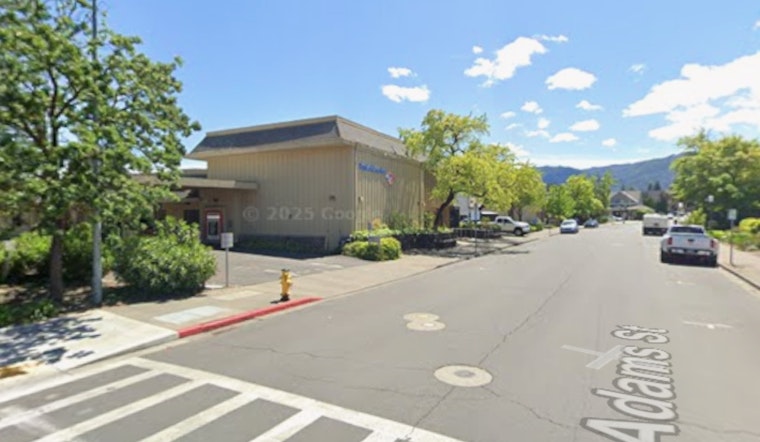
The vacant Bank of America building on Adams Street could soon swap tellers for turndown service, as St. Helena officially launches environmental review for a proposed luxury hotel and residences at the site. The city held a public scoping meeting last Thursday and is accepting written comments through 5 PM on April 20. Developer Antonio Castellucci is proposing a five-story complex that would bring dozens of guest rooms and resort condominiums to downtown St. Helena.
According to the City of St. Helena, a Notice of Preparation for a Draft Environmental Impact Report was issued in March, with the city named as lead agency. The public scoping session took place at the Carnegie Building, and Linda Ruffing of North Coast Community Planning is listed as the contact for public and agency comments.
State filings show the Castellucci Adams Street Hotel & Residences would occupy a 1.17-acre parcel at 1001 Adams Street and would construct a roughly 104,000-square-foot, 59-foot-one-inch-tall structure with 74 guestrooms, 14 for-sale condominium residences and a 39,549-square-foot basement garage with 113 parking spaces, according to CEQAnet. The filing lists about 37 full-time-equivalent employees and amenities that include a restaurant, spa, pool terrace and a 2,400-square-foot conference room.
Speakers at the scoping meeting raised concerns about water, noise and event-related traffic, and one resident, Tom Belt, urged that the hotel be water-neutral. They also asked that the Environmental Impact Report study cumulative effects from other planned projects, including the approved Hunter housing development, as reported by the Napa Valley Register. The Register quoted the city's planning consultant as saying a draft EIR should be released this fall, roughly six months after the notice, and noted projections that hotel-related taxes could generate about $2.5 million to $3 million annually for St. Helena. The Register also reported that the final EIR is scheduled to go to the Planning Commission and City Council for public hearings and possible approval in early 2027.
What Comes Next
The EIR is expected to examine a wide range of topics, from traffic and water supply to historic resources and wildfire risk, and it will be revised to address public and agency comments before any certification, according to state filings. The proposal will require several discretionary approvals, including a general plan amendment, rezoning with a planned development overlay, a tentative subdivision map, a conditional use permit, major design review, a demolition permit and a development agreement. Those approvals will be decided at later public hearings before the Planning Commission and City Council, according to CEQAnet.


