

























































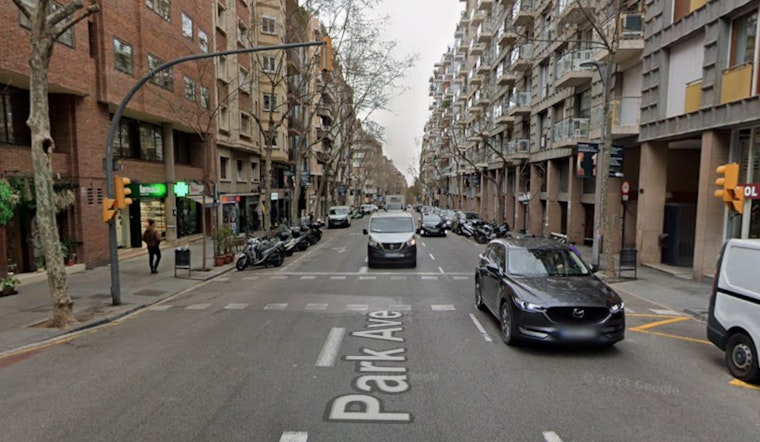
Bronx firefighters say a set of concrete bike lane barriers on Park Avenue turned a routine truck placement into a high-stakes gamble during a recent apartment fire, blocking a ladder truck’s stabilizers and forcing them to improvise while pulling residents from an upper-floor blaze.
Union representatives warn the tight spacing around those concrete dividers made it unsafe to fully deploy the truck’s outriggers, raising the risk that the rig could tip and cause serious injury or death. Firefighters stress they are not against protected bike lanes, but say the way some of them are built is putting emergency access on the line when seconds matter.
During a fire last Sunday on East 174th Street, crews used a ladder truck to rescue six people from a burning building. According to News 12 New York, firefighters said they could not fully extend the truck’s stabilizing legs because concrete barriers separating the Park Avenue bike lane had narrowed the roadway too much. That obstruction limited where they could position the truck and cut down the angles they had to reach trapped residents, union leaders told the outlet, adding that the backup stabilization methods they used are less effective and more dangerous.
Park Avenue Hardening And The Trade Offs
The concrete "jersey" barriers are part of a New York City Department of Transportation push to harden protected bike lanes along Park Avenue. The agency’s project pages list improvements on the corridor from East 165th Street to East 188th Street. According to NYC DOT, the goal is to make cycling safer in neighborhoods that have few protected north-south options.
Critics, however, say some of that hard infrastructure is coming with side effects. Streetsblog New York City has documented drivers parking inside hardened bike lanes and design choices that can make general street access more difficult. Firefighters now argue that in certain spots, those choices may also be narrowing the margin for safe emergency operations.
Fire Crews Call For Flexible Protections
Firefighters say the problem is not the presence of bike lanes, but the rigidity and placement of the barriers that line them.
"They help stabilize the fire truck so that when the aerial ladder goes up, the truck doesn’t tip over," Bronx trustee Marc Doré told News 12 New York, referring to the outriggers that extend from a ladder truck. Doré said crews are not opposed to protected bike lanes at all, but urged the city to look at using flexible or movable materials that could bend or be shifted out of the way so emergency vehicles can get proper footing when there is a fire.
Aerial fire trucks rely on outriggers - hydraulic stabilizers that extend from the rig to create a wider footprint and keep the truck from tipping when the ladder is raised. Manufacturers and national fire standards emphasize that those stabilizers need clear ground to seat properly. Pierce Manufacturing notes that stabilizers and outriggers are engineered to meet NFPA stability requirements, which assume the pads can rest on unobstructed surfaces.
Fire departments warn that rigid curbs and closely spaced concrete dividers can prevent outriggers from fully deploying, which limits both the reach and the angle of aerial operations. Streetsblog New York City has also shown how tight spacing and illegal parking around hardened bike lanes in the Bronx can further cut down the options for where crews can safely set up.
Union leaders and advocates are now pushing for a joint review between FDNY and DOT to map out where hardened infrastructure could conflict with emergency operations and to test alternatives such as flexible or removable protection. The DOT’s project pages say the agency already conducts community outreach and works with other city departments during design and construction, and firefighters argue that forum should be used to make sure cycling safety upgrades do not box out first responders.
Local community boards and elected officials are expected to be part of any discussions over design changes as the city continues expanding protected bike lanes elsewhere in the Bronx.
Designing bike lanes that keep cyclists safe while still leaving room for ladder trucks is not an easy puzzle, but firefighters and advocates say it is a solvable one if the city rethinks materials and spacing. For now, crews are asking planners to treat emergency access as a core part of the safety equation, not something to fix after the concrete is already poured.





