

























































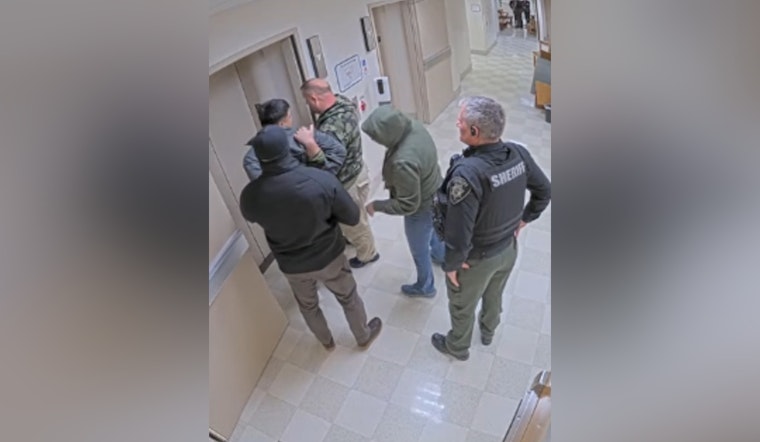
Federal immigration agents arrested two people inside the Marion County Courthouse in downtown Salem on March 26, and now the Oregon Department of Justice is taking a hard look at what happened in those fifth-floor hallways.
Courthouse video from that morning shows one person taken into custody on a judge-signed federal arrest warrant and another detained in what officials describe as an administrative immigration action. The different types of warrants, combined with the footage itself, have drawn scrutiny from state officials, lawmakers and local advocates who are asking whether Oregon’s sanctuary protections were followed inside the courthouse.
The DOJ’s Civil Rights Unit “received a report” about the incident and contacted the Marion County Sheriff’s Office, according to Oregon Capital Chronicle. The inquiry is focused on whether legal action or other remedies are warranted under Oregon law. The Capital Chronicle also reports that the state flagged the matter after local outlets requested and reviewed the courthouse video.
Marion County officials say Department of Homeland Security agents notified courthouse staff shortly after 8 a.m. and presented a U.S. District Court arrest warrant for one of the men, which deputies verified before taking him into custody. County spokespeople say deputies did not participate in the administrative arrest, and instead escorted federal agents through publicly accessible areas as they removed the other person. Sheriff Nick Hunter said, “Our Judicial Security team acted professionally, remaining focused on their mission.” For the sheriff’s full statement and the posted footage, see the Marion County Sheriff’s Office.
What the video shows
The courthouse clip, which has no audio, shows agents in the fifth-floor hallway restraining a man while deputies stand nearby. Local reporters say the footage depicts a physical struggle that ends with the detainee being led away in handcuffs. Coverage by the Salem Reporter and other local outlets notes that one man was in court for scheduled criminal proceedings, while the other appears to have been taken under an administrative immigration action. The images have fueled calls from advocacy groups and public defenders to identify witnesses and determine whether courthouse procedures were followed.
Why the warrants matter
Under Oregon’s judicial guidance, the type of warrant is not just a technical detail, it is central to how arrests are supposed to work in and around courthouses. Chief Justice Meagan Flynn’s interim order states that “civil arrests in or around court facilities without a judicial warrant or judicial order are prohibited,” and it directs court staff to refer immigration agents to a designated judicial officer, according to Chief Justice Order No. 25‑018. That prohibition lines up with statutory protections that were enacted and then strengthened by the 2021 Sanctuary Promise Act.
The Oregon DOJ’s Sanctuary Promise materials explain that the Civil Rights Unit can open non‑punitive inquiries and that its reports may be subpoenaed by community members seeking injunctive relief, according to Oregon DOJ. In practical terms, a state review could generate documentation that private litigants might use, even if the department itself decides not to pursue sanctions.
What could happen next
State Rep. Willy Chotzen says he wants a full investigation. He told the Oregon Capital Chronicle that the footage “shows something that is very alarming” and appears to show a potential sanctuary-law violation.
Legal scholars interviewed by reporters caution that finding a remedy will not be straightforward. Lewis & Clark law professor Tung Yin told the Capital Chronicle that a removed person “probably would not have a claim under state law,” highlighting the difficulty of suing on behalf of someone who is already out of the country.
Federal agencies did not immediately provide a full accounting to local reporters, and the state review remains open as investigators and advocates push for more clarity about what happened and who saw it, according to the Salem Reporter. The Marion County Sheriff’s Office and the Oregon DOJ have issued public statements but have otherwise shared limited additional detail while the inquiry continues.



