

























































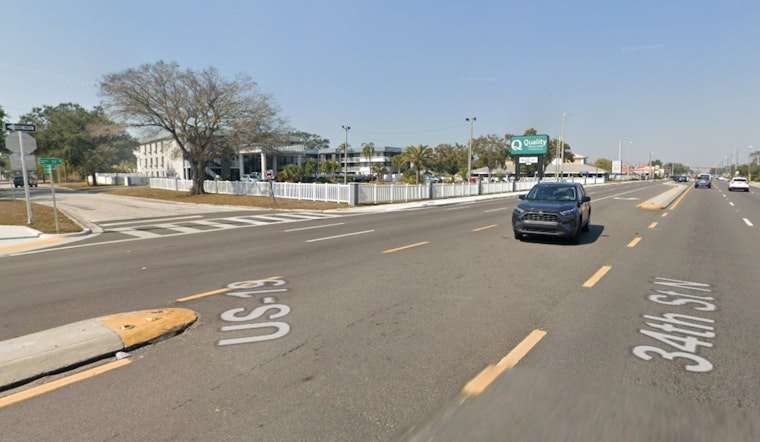
A routine Monday morning on one of St. Petersburg's busiest corridors ended in tragedy when a 78-year-old driver from Illinois suffered a medical episode behind the wheel and lost control of his SUV along 34th Street North.
Witnesses told police they saw a red Jeep Compass Trailhawk weaving through northbound traffic shortly after 9:20 a.m. in the 1200 block of 34th Street North. Moments later, the SUV left the roadway, hit a street sign at the intersection of 14th Avenue North and 34th Street North, and continued on until it came to rest in a driveway at 1390 34th St. N.
First responders rushed the driver to Orlando Health Bayfront Hospital, where he was pronounced dead soon after arrival. Police reported that no other vehicles were involved in the crash and no bystanders were hurt.
According to Tampa Free Press, St. Petersburg police identified the driver as 78-year-old Ralph Locke of Chicago, Illinois. Officers began their on-scene investigation at the driveway where the vehicle came to a stop, working to piece together how a medical emergency turned a late-morning drive into a fatal incident.
How often do medical events cause crashes?
Crashes triggered by a driver's medical emergency are relatively rare, but they can be especially serious when they do happen. A review of federal crash data by the National Highway Traffic Safety Administration found that about 1.3% of crashes in the National Motor Vehicle Crash Causation Survey were linked to a medical event.
Within that sliver of cases, older drivers and morning driving hours showed up more often than in other crashes. The analysis pointed to seizures, blackouts and diabetic reactions as some of the most frequent medical triggers, and it noted that drivers involved in these types of crashes faced a higher likelihood of incapacitating injury or death.
What investigators and lawyers will look for
St. Petersburg police say the crash remains under investigation and that no bystanders were injured, as reported by Tampa Free Press. In cases like this, investigators typically dig into vehicle data, speak with witnesses and review medical examiner findings to determine whether a sudden health problem was the key factor behind the loss of control.
Legal analysts note that when a medical emergency is both sudden and unforeseeable, it can shape how civil liability is viewed in the aftermath of a crash. Outcomes can hinge on details such as the driver's documented medical history and whether the condition at issue might reasonably have been anticipated. For a broader breakdown of how courts approach these situations, see Nolo.





