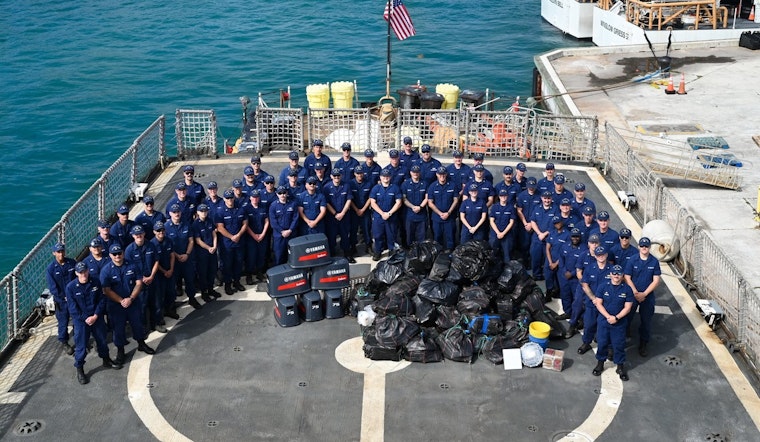
Nearly 4,000 pounds of cocaine, stacked in tightly wrapped bales and tagged as evidence, were hauled off a U.S. Coast Guard cutter and onto the pier at Coast Guard Station Miami Beach on Thursday. Federal officials put the load’s street value at roughly $28.7 million. Crews say the drugs were scooped up after two suspected smuggling boats were intercepted at sea, the latest haul in what has become a steady drumbeat of maritime drug busts in recent months.
Haul Brought Ashore at Miami Beach
According to WSVN, Coast Guard teams offloaded the shipment after stopping two suspected smuggling vessels in the Pacific Ocean and transporting the seized cocaine to Station Miami Beach. The outlet reports the take as "nearly 4,000 pounds" and cites the agency’s estimated street value of more than $28.7 million.
Part of a Bigger Pacific Sweep
This offload is one slice of a much larger campaign. The seizures are tied to Operation Pacific Viper, the Coast Guard’s Eastern Pacific surge effort that began in August 2025 with the goal of disrupting cartel drug runs before they get anywhere near U.S. shores. Federal figures put total Operation Pacific Viper cocaine seizures well above 200,000 pounds, with some coverage citing totals north of 215,000 pounds and roughly 160 suspects taken into custody, Fox News noted.
Miami Beach's Role
Miami Beach is no stranger to scenes like Thursday’s. Coast Guard Station Miami Beach and nearby Base Miami Beach are regular landing spots for big drug offloads. In December 2025, crews brought in about 3,715 pounds of cocaine worth an estimated $28 million after an interdiction off South Florida. That earlier bust, carried out with help from CBP Air and Marine Operations and Homeland Security Investigations, was described by the service as the largest small-boat station seizure since 1995, according to the U.S. Coast Guard.
What Comes Next
From the pier, the bales do not stick around long. After offloads, the narcotics are catalogued, packed back up under tight security, and moved into federal evidence custody while criminal investigations roll on. Local commanders often point to seizures like this as hits to cartel profits and supply chains, even as they acknowledge that high-seas drug busts are only one piece of a much broader law-enforcement and public-health response.