

























































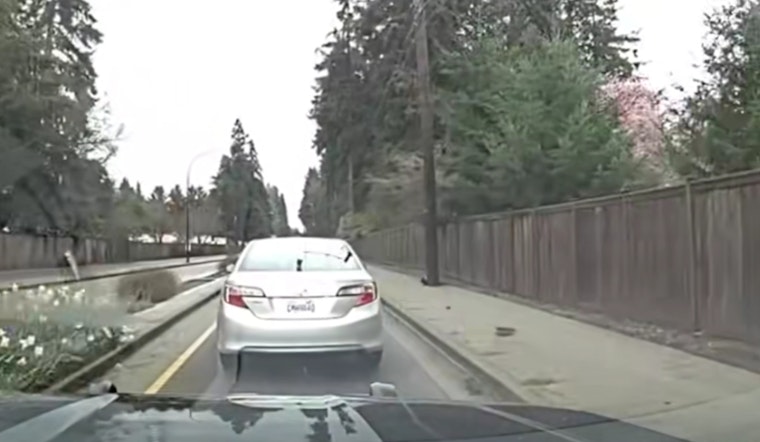
A stolen car, a fleeing driver, and no high-speed chase. Puyallup officers say they used a GPS tracker to quietly follow a stolen vehicle after a Flock alert, then moved in once it rolled to a stop in a nearby neighborhood. Dash-cam footage posted by the department shows officers tagging the car, backing off, and later making the arrest. Police say they recovered a firearm and marijuana from the suspect’s backpack and obtained a warrant for a blood draw.
According to the Puyallup Police Department, the whole thing started on March 20 with a Flock alert that flagged a stolen vehicle. Officers located the car, confirmed it was listed as stolen, and tried to pull it over. When the driver hit the gas instead, officers did not engage in a pursuit. Instead, they attached a GPS tracking device to the vehicle, then monitored its movements from a distance until it stopped in a residential area.
As reported by KIRO 7, dash-cam video shows the tracker being deployed while officers follow at a controlled speed through neighborhood streets. When the car finally came to a stop and officers moved in, the driver tried to run but was quickly taken into custody. KIRO reports that officers found a gun and marijuana in the suspect’s backpack during the arrest.
How the Flock alert and GPS tagging work
Flock’s camera network uses automated license-plate readers to generate real-time “hotlist” alerts when a plate matches a stolen vehicle or another flagged entry, according to Flock Safety. Agencies can see multiple reads on a plate, which lets them follow a car’s movements over time instead of relying on a single sighting.
Policy analysts say that kind of tracking can act as a force multiplier for finding stolen cars and can also help officers avoid risky pursuits by letting technology do the chasing. At the same time, it raises familiar questions about how long plate data is stored, who can access it, and how it can be used. A review of license-plate-reader programs by RAND highlights both the investigative benefits and the privacy, oversight, and data-management issues that typically come with LPR systems.
Legal next steps
Police have not released the suspect’s name and have not said whether prosecutors have formally filed charges. KIRO 7 reports that officers obtained a warrant for a blood draw after noting signs of impairment. In its post on the incident, Puyallup police wrote that “training, technology, and teamwork brought a dangerous situation under control without a pursuit,” and investigators say they will forward the evidence to prosecutors as standard procedure.
The stop comes as Washington lawmakers and watchdogs continue to debate how far automated license-plate-reader systems like Flock should go. Bills such as SB 6002 have prompted calls for clearer rules around how long plate data is kept and who is allowed to see it. Observers say the Puyallup case has quickly become a real-world example of the tradeoff: using powerful tracking tools to cut down on high-speed chases while also facing pressure for transparency and safeguards. The municipal research group MRSC has been following that policy fight in Olympia.





