

























































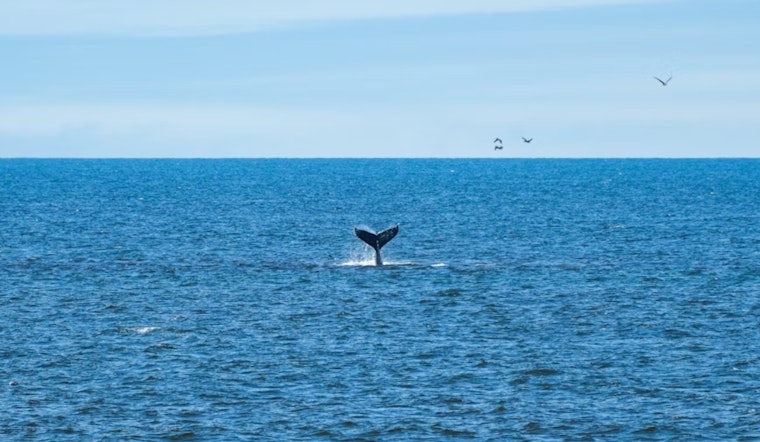
A new federal bill out of Congress would plant a dedicated Coast Guard "whale desk" in San Francisco, aiming to cut the deadly ship strikes that keep turning up in Bay waters. Introduced yesterday, the "Save Willy Act," authored by Rep. Sam Liccardo (CA-16), would set up real-time tracking and public reporting so whale sightings from mariners and shoreline observers can be routed to vessel operators and traffic services. The proposal lands amid an unusually high number of local whale deaths that conservationists say demand much faster coordination between researchers and the maritime industry.
The legislation was rolled out with a broad Bay Area coalition behind it and would also direct the U.S. Coast Guard to evaluate technologies to detect whales and alert ships before collisions occur. According to KTVU, cosponsors include Representatives Jimmy Panetta, John Garamendi, Zoe Lofgren, Ro Khanna, Kevin Mullin, Robert Garcia, Mike Levin and Ted Lieu.
Advocates point to a recent spike in fatalities as the reason for urgency. As reported by KQED, the Bay Area recorded 24 whale deaths in 2025, 21 of them gray whales, and so far in 2026, seven gray whales have died inside the Bay, with two more in surrounding waters. State regulators are expanding a voluntary vessel speed reduction program this week, a move supporters say has to be paired with better reporting and real-time alerting if it is going to make a real dent in those numbers.
"Oceana strongly supports this bill," Geoff Shester, Oceana’s California campaign director, said in the rollout, a statement cited by KTVU. Kathi George of The Marine Mammal Center underscored the role of the Coast Guard’s Vessel Traffic Service in turning raw sightings into practical advisories and safer routes for mariners.
What The Save Willy Act Would Do
The bill would create a dedicated "whale desk" at the Coast Guard’s San Francisco station to receive reports from the public, ferries, commercial ships and other operators, then push out alerts to vessel crews when whales move into Bay waters. It would also instruct the Coast Guard to evaluate and pilot a range of detection technologies, from acoustic sensors to near-real-time sighting networks, and to tighten coordination between ports, bar pilots and recreational fleets. Those mechanics are laid out in the initial coverage of the proposal by KQED.
Why Whales Are Pushing Into The Bay
Federal studies and researchers report that eastern North Pacific gray whale numbers have declined in recent years, with a 2025 abundance estimate of about 13,000 animals, the lowest since the 1970s. Scientists point to shifts in Arctic feeding grounds and reduced prey as likely drivers of the atypical visits into San Francisco Bay, where whales appear to be ranging farther in search of food. NOAA investigators and independent scientists have linked malnutrition and lower calf production to those ecosystem changes, according to reporting by The Associated Press. That ecological squeeze makes already busy shipping corridors even more dangerous for the animals.
Local Response And Next Steps
On the ground, The Marine Mammal Center and regional responders are continuing necropsies and field monitoring to better pinpoint the causes of recent deaths, while ferry captains and commercial skippers say they are already easing speeds and tweaking routes when whales are spotted, according to local reporting. Community groups and scientists stress that public sightings, logged responsibly through established channels, are a crucial piece of any rapid alert system that could feed a Coast Guard whale desk and help trigger temporary slow zones.
Legislative sponsors note that the bill still has to clear committee steps and win federal buy-in before any appropriations or pilots can be funded, and they argue that combining federal coordination with state speed programs gives the region its best shot at cutting collisions. In the meantime, mariners and shoreline observers are being urged to log sightings and use tools such as WhaleAlert so managers and vessels can act on near-real-time information.





