

























































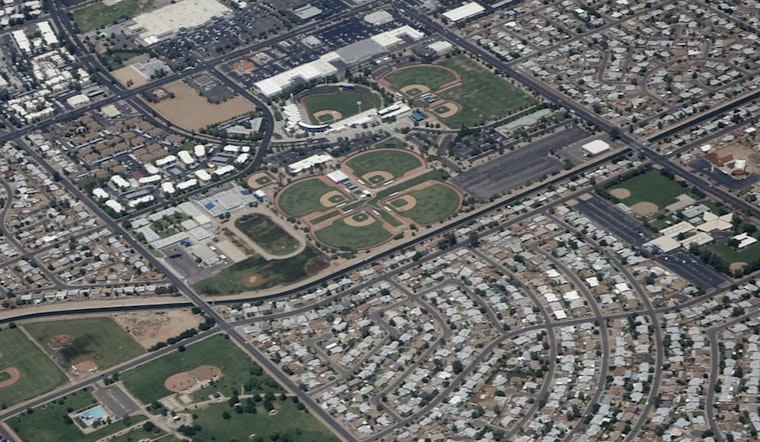
Maryvale residents and organizers this week kicked off Resilient Phoenix, a neighborhood-led plan to cool one of Phoenix’s hottest corners with more trees, engineered shade and a bold “sponge oasis” idea that would reuse treated graywater for irrigation. The effort grew out of community research that put shaded parks, shaded walking routes and shaded public parking at the top of residents’ wish lists. Organizers say the work will roll out over the coming months, with public meetings and interim reports before a fuller strategic plan is published later this year.
Organizers including RUMBO and GreenLatinos say they will hold a climate town hall in Maryvale on May 20 and plan to release an initial report at that meeting, according to KTAR. A related program listing at Arizona State University describes the Resilient Phoenix report as community research translated into policy options and highlights RUMBO’s role in neighborhood outreach. The ASU entry frames the project as a bridge between resident-led findings and city-level planning.
Why Maryvale?
Maryvale sits near the bottom of the city’s tree-canopy rankings, at roughly 7.8% canopy compared with a citywide median near 11%, per the City of Phoenix Shade Phoenix plan (Shade Phoenix plan). Organizers and residents say those canopy gaps show up as much hotter public spaces; they told KTAR that some blocks feel four to seven degrees warmer than greener neighborhoods. “It’s just really, really hot and it is getting hotter,” an organizer said in remarks reported by KTAR.
What a sponge oasis would do
The sponge-oasis concept lays out a mix of nature-based and small-scale built interventions: pocket parks, cooler corridors, shaded parking retrofits and managed water features that use treated graywater to keep trees and plazas healthy through long summers. That vision, including the idea of reusing household graywater to sustain surface irrigation, was described by the Office of Urban Resilience in a recent post outlining the project as a Maryvale prototype. Organizers say the combination is meant to deliver fast, site-level cooling while longer-term canopy investments mature.
Neighbors already planting
Resilient Phoenix builds on earlier greening work in Maryvale: partners such as the Arizona Community Foundation, SRP and local volunteers have already helped plant trees in neighborhood parks as part of broader cooling efforts, according to Prensa Arizona. Those initial plantings are being treated as testbeds for what larger investments could accomplish if paired with long-term maintenance and funding commitments. Community groups say tying these volunteer projects into city programs will be essential so young trees survive Phoenix summers.
How the city fits in
The Resilient Phoenix work ties into the city’s Shade Phoenix effort, which lays out dozens of actions to expand shade across neighborhoods and public spaces. Per the City of Phoenix, the plan calls for 27,000 new trees and 550 new shade structures over the next five years to target heat-vulnerable areas. Local reporting and planning coverage have also cited a roughly $60 million multiyear funding envelope linked to those shade and planting goals, which could help neighborhood pilots move from design to installation.
Graywater rules and hurdles
Reusing household graywater at scale is technically possible in Arizona but regulated, with state reclaimed-water rules (Arizona Administrative Code provisions covering recycled water and graywater permitting) setting conditions, limits and best-practice requirements to protect public health, per analysis by water-reuse experts and national reuse stakeholders. That means any Maryvale pilot that depends on graywater would need careful engineering, monitoring and local approvals before it could be rolled out across streets or parks.
Organizers say Resilient Phoenix will keep residents and city agencies in close conversation as they test which cooling measures work fastest and at scale, with a May 20 town hall scheduled to share early findings and a fuller strategic plan targeted for December. Residents interested in the project are being encouraged to watch for outreach from RUMBO and partner groups in the coming weeks as the initiative moves from design toward pilot projects.





