

























































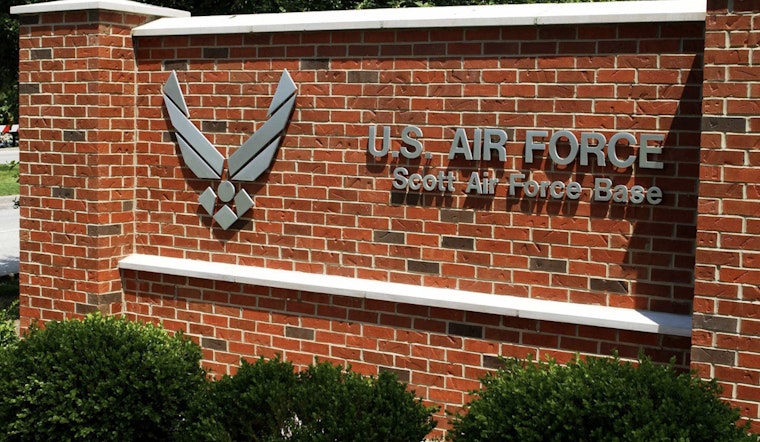
Scott Air Force Base is not just the neighbor behind the security gate - it is one of the Metro-East’s largest economic engines, driving roughly $12.9 billion in annual activity and propping up thousands of jobs across the region. A new regional analysis paints Scott as a powerful payroll machine, a steady source of retiree income and a magnet for construction and private-sector investment in communities from Belleville to Mascoutah.
A report commissioned by the Leadership Council Southwestern Illinois and prepared by Steadfast City pegs Scott AFB’s total annual economic impact at about $12.9 billion. That includes roughly $8.8 billion in direct output and 8,923 direct full-time equivalent jobs, with about 39,712 full-time equivalent jobs supported across the wider region. The study also estimates the base generates about $909 million in direct payroll and sends roughly $383 million a year in military retirement payments into the local economy, according to Leadership Council Southwestern Illinois.
How the study breaks down the impact
The analysis splits that economic punch into three buckets: about $8.85 billion in direct impacts, roughly $536 million in indirect supply-chain effects and about $3.56 billion in induced impacts from employee spending. Regional economic summaries echo those totals and highlight Scott’s role in anchoring nearly 40,000 full-time equivalent jobs across Southwestern Illinois, Envision Southwestern Illinois.
Airport ties and taxpayer questions
Scott’s footprint is tightly bound up with MidAmerica St. Louis Airport. The airport reported a record 384,000 passengers in 2025 as carriers and onsite manufacturers expanded operations, and Boeing wrapped up a new production facility on the field last year, according to First Alert 4 (KMOV). At the same time, county audits and industry coverage show St. Clair County still kicks in more than $6.5 million a year to keep MidAmerica operating for joint military-civilian use, AviationPros (via BND/TNS).
Schools and local services
The study also tracks how federal dollars tied to Scott show up in classrooms and local services. Ten school districts in the base’s local economic area received about $20.14 million in Section 7003 impact-aid payments in fiscal 2024, according to the report. Those federal payments, combined with construction spending and civilian wages linked to base activity, form a key part of the case local officials make when arguing for continued investment in the airport and surrounding infrastructure, according to Leadership Council Southwestern Illinois.
Why this matters now
Although the analysis focuses on the 2024-2025 period, it lands in the middle of a major infrastructure push. The state’s Rebuild Illinois program includes $96 million for a MetroLink extension to MidAmerica, and St. Clair County transit officials say the 5.2-mile extension is scheduled to open this summer. Together, those moves more tightly link transit, the airport and the base. Those projects, along with recent manufacturing expansion at the airfield, form the immediate policy backdrop for the renewed attention on Scott’s numbers, per Rebuild Illinois and the St. Clair County Transit District.
Local leaders push the case
Leadership Council officials are pitching the report as a playbook for lawmakers and business leaders. In a message introducing the study, the council’s Chris Blair and Kyle Anderson wrote that the analysis “will serve as a valuable resource for decision-makers” as the region seeks advocacy and investment. Whether that turns into fresh appropriations or tougher scrutiny of ongoing airport subsidies will be up to county boards and state lawmakers in the months ahead.
For Metro-East residents, the bottom line is straightforward: the base’s paychecks, retiree benefits and contract spending ripple through schools, shops and construction sites. That steady flow of money is a big reason Scott AFB keeps landing at the center of regional planning talks and local budget fights.





