

























































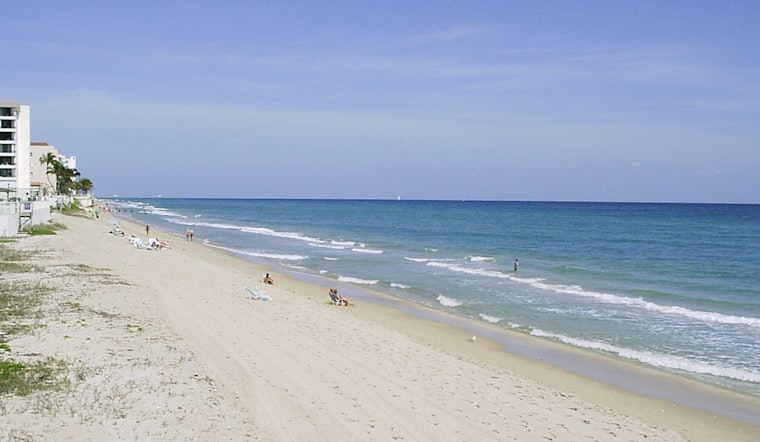
Winter beach-renourishment projects meant to keep South Florida’s shoreline in shape might also be stirring up trouble in the surf. A new study from Florida Atlantic University finds that these projects can create long-lasting clouds of sediment that overlap with huge seasonal aggregations of blacktip sharks, potentially nudging the odds of unpleasant shark encounters higher for swimmers.
The research team tracked nearshore turbidity and animal activity during the 2020 to 2021 seasons, and their bottom line is fairly simple: when beach work ramps up in winter, people and sharks can end up in the same strip of murky water at the same time.
To get there, researchers combined monthly low-altitude aerial surveys, which produced more than 10,000 images, with underwater camera stations set at different distances from shore to map water clarity and record shark and fish behavior. Over two seasons, they documented 24 sediment plumes, some stretching nearly 15 kilometers along the coast and more than 250 meters offshore, that sharply reduced nearshore visibility, according to Florida Atlantic University.
“The timing couldn’t be worse,” said study co-author and FAU shark researcher Dr. Stephen Kajiura, noting that blacktip sharks spend the winter off South Florida, then migrate north along the beach in spring. He told WPBF that murky water makes it harder for sharks to visually distinguish prey from swimmers, raising the potential for “really bad, negative encounters.”
How Cloudy Water Can Throw Sharks Off Their Game
In the nearshore zone, FAU scientists observed that blacktip sharks tend to hug the shoreline, usually within about 50 meters, where baitfish are thickest. These sharks rely heavily on vision to hunt, and the study suggests that prolonged low visibility can disrupt that system. When sharks cannot see as well, their distribution and feeding behavior may shift in ways that put them in closer, riskier overlap with humans using the same shallow waters, according to Phys.org.
What Coastal Managers And Swimmers Should Keep In Mind
The authors are not calling for an end to beach renourishment. They describe it as a key tool for coastal protection but argue that its ecological and public safety tradeoffs need to be considered earlier in the planning process. They recommend better monitoring, more careful sediment management, and serious thought about scheduling projects to reduce overlap with peak shark migrations and the busiest beach days, according to Florida Atlantic University.
Why Sediment Plumes Travel So Far And Stick Around
Coastal monitoring and numerical modeling show that fine-grained material like silt and clay can stay suspended in the water column and be pushed long distances by waves and currents. In the surf zone, elevated concentrations can linger for days after the sand is placed, helping to explain why nourishment-related plumes can stretch for kilometers and remain in place during important windows of shark activity, according to the U.S. Geological Survey.
The findings are detailed in a peer-reviewed paper in the Journal of Coastal Research and give local agencies another data point as they map out future renourishment schedules. The study’s release highlights plume modeling, tighter monitoring, and seasonal timing tweaks as practical steps to cut down overlap between sediment clouds and shark aggregations, according to EurekAlert!.




