

























































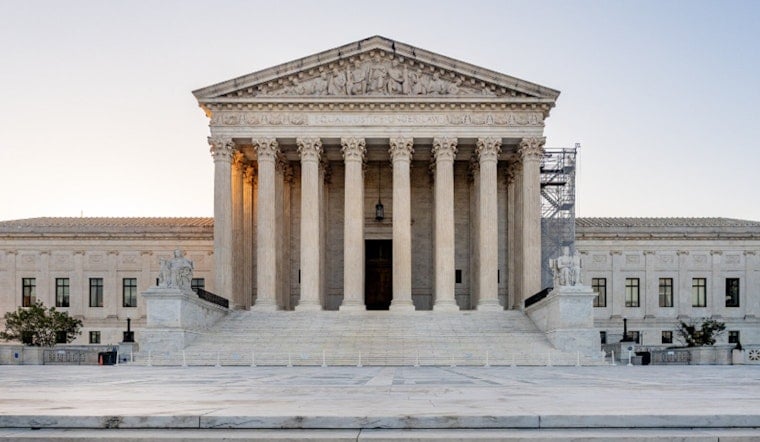
The U.S. Supreme Court is weighing how far the Securities and Exchange Commission can go when it orders alleged fraudsters to cough up their profits, even when no investor can show a clear dollar loss. On Monday, the justices heard arguments in Sripetch v. SEC, a case that could sharply curb the agency's use of disgorgement - the SEC's go-to tool for stripping ill-gotten gains - unless victims can show "pecuniary harm." Whatever the outcome, the ruling is set to ripple through settlement talks, investor restitution, and enforcement strategy across the country.
At the center of the fight is Ongkaruck Sripetch, a trader who pleaded guilty in a related criminal case. In federal court, he was ordered to disgorge roughly $2.25 million in net profits plus about $1.06 million in prejudgment interest, and he received a 21-month prison sentence. The Ninth U.S. Circuit Court of Appeals upheld the civil disgorgement award, and the Supreme Court stepped in after lower courts split on whether disgorgement requires proof that investors actually lost money. Those developments are detailed by Reuters and in a press release from the Justice Department.
What the court will decide
The justices are focused on a narrow but loaded question: can the SEC seek "equitable disgorgement" under 15 U.S.C. § 78u(d)(5) and (d)(7) without proving that investors suffered measurable financial harm, or must the agency tie any disgorgement award to victim losses?
That dispute traces back to the Supreme Court's 2020 decision in Liu, which held that disgorgement cannot exceed a wrongdoer's net profits and should be awarded "for victims," and to a 2021 congressional amendment that added a standalone disgorgement provision for the SEC. Federal appeals courts have since read those cues differently: the Second Circuit has required proof of investor loss, while the Ninth Circuit and several others have not. That clash is what drew the Supreme Court into the fray, as explained by Venable LLP.
Why it matters
This is not some academic food fight. Disgorgement is one of the SEC's biggest financial weapons, both in terms of headline recovery numbers and in the quiet leverage it provides behind closed-door settlement talks.
In fiscal 2024, the SEC secured roughly $6.1 billion in disgorgement and prejudgment interest, and about $1.4 billion in fiscal 2025 after adjusting for certain large "deemed satisfied" items, according to figures cited by reporting outlets and industry analysts. A ruling that insists on proof of pecuniary harm could chop those numbers, especially in cases where losses are widespread, indirect, or simply hard to pin down with a calculator. That, in turn, could reshape which cases the SEC pursues, how it negotiates, and what kind of relief investors actually see, as discussed by Bloomberg.
On the briefs
The United States, defending the SEC, has urged the Court to preserve the agency's power to seek disgorgement without forcing it to prove separate investor losses every time. The government's brief leans on the statutory text, the history of equitable remedies, and prior Supreme Court precedent.
On the other side, a crowded lineup of amici - from trade associations to think tanks and restitution scholars - is pulling the Court in competing directions. Business and libertarian groups such as the Washington Legal Foundation and the Cato Institute are pressing for tighter limits on disgorgement, warning of overreach and quasi-punitive remedies that go beyond compensating victims. Other briefs counter that the common-law history of restitution supports disgorgement even when direct victim losses are hard to calculate. The respondent filing from the United States can be found on the Supreme Court docket, alongside a stack of amicus briefs staking out those positions.
Legal implications
If the Court rules narrowly for Sripetch, expect the SEC to retrench around cases where investor harm is both concrete and provable, and to see smaller recoveries in matters involving diffuse or hard-to-measure injuries. That kind of ruling would also invite fresh battles over who counts as a "victim" and what qualifies as "pecuniary harm" in complex markets.
Congress would not be sidelined either. A decision that significantly trims the SEC's disgorgement authority could spur lawmakers to revisit the statute, just as they did after earlier Supreme Court guidance on the remedy. Securities lawyers, meanwhile, are already gaming out these scenarios in firm alerts and client calls, including a year-end overview from Gibson Dunn.
What to watch next
With oral argument now complete, the justices are expected to rule before the term wraps up in late June. A key signal will be how the opinion stitches together the 2021 statutory language with the limits the Court announced in Liu.
A win for Sripetch would narrow one of the SEC's most potent enforcement tools in cases where there are no easily identified, dollar-for-dollar victims. A win for the agency would keep intact its ability to strip illicit profits even when sorting out which investors lost what would be a logistical nightmare. For case tracking and in-depth argument analysis, follow coverage at SCOTUSblog.





.jpg)