

























































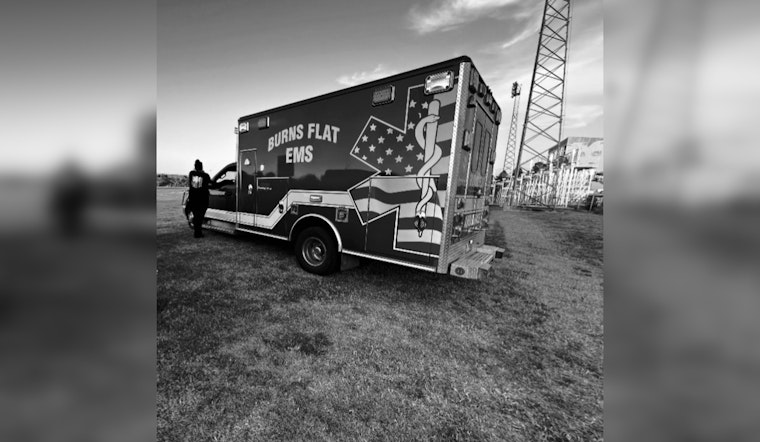
Burns Flat's city ambulance service is on the verge of going dark after every medic announced plans to resign, a move that could leave the tiny western Oklahoma town without its usual pre-hospital squad. The resignations are scheduled to take effect June 1, raising an immediate and uncomfortable question: who shows up when someone dials 911? For now, town leaders have lined up temporary help from a neighboring provider while they sort through longer-term options.
According to KOKH / FOX 25, Burns Flat EMS posted that every medic is submitting a resignation effective June 1, 2026, and reported that EMTs at the service were being paid just $4.58 an hour, with additional compensation only when a 911 call came in. The agency's message pointed to staffing shortages, burnout and low reimbursement rates that make operating a small-town EMS service financially shaky. "If love alone could have kept the doors open, Burns Flat EMS would have survived forever," the post said.
Sinor EMS to provide temporary coverage
Starting June 1, neighboring Sinor EMS is set to cover the Burns Flat area from its Clinton and Hobart stations while local officials search for a permanent fix. As KOKH / FOX 25 reports, officials described the arrangement as "a temporary solution until a more permanent solution is decided upon" and acknowledged they do not yet know how response times will be affected. Town leaders say they are coordinating with surrounding services in an effort to keep 911 coverage intact during the transition.
How Burns Flat's EMS is organized
State records list Burns Flat Ambulance as a licensed Basic Life Support agency (license EMS‑084), according to the Oklahoma State Department of Health. The town's own website describes a volunteer Fire/EMS program overseen by Samantha Paustell and Rayanna Fisher, a reminder that this is a small operation where a few people wear many hats, per the Town of Burns Flat. That mix of volunteers and limited paid staffing, officials and advocates say, leaves departments exposed when the core group of paid personnel steps away.
Why rural EMS keeps collapsing
Across rural America, ambulance services are wrestling with the same trio of problems: weak reimbursement, an aging volunteer workforce and razor-thin margins that leave little room for error. A policy brief from the National Rural Health Association warned that nearly one third of rural EMS agencies are in "immediate operational jeopardy" because they cannot cover their costs. At the same time, the Bureau of Labor Statistics reports a median annual wage for EMTs of about $41,340 (May 2024), a national figure that highlights how far Burns Flat's reported hourly rate sits below typical pay.
What residents should know
Town officials say Sinor's coverage is intended as a stopgap while a more durable plan is worked out, and residents are urged to continue calling 911 in an emergency as usual. Sinor's website lists its Clinton and Hobart stations and contact numbers, which local leaders say will be used to coordinate ambulance coverage for Burns Flat. For non-urgent questions about local services, residents can reach Burns Flat Town Hall using the contact information posted on the town's website.
The abrupt resignations put a blunt spotlight on a stubborn funding problem for rural public safety: without better pay and stable revenue streams, small-town EMS operations will keep fighting to survive. Local leaders and state officials now face the practical task of finding a sustainable model that keeps an ambulance available when Burns Flat residents need it most.


