

























































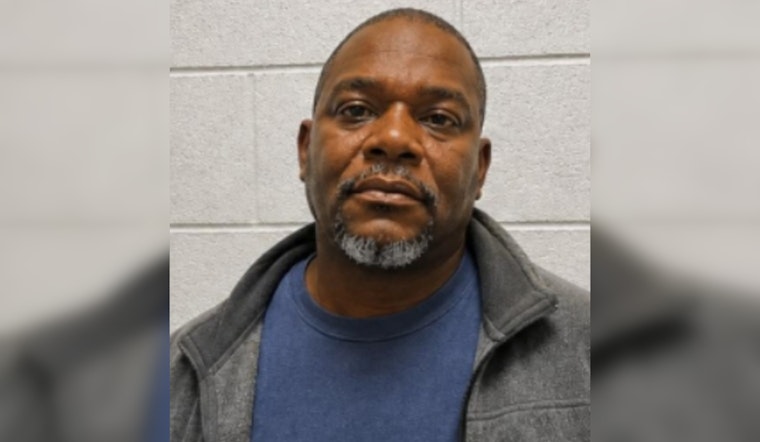
Raleigh police say a long-dormant sexual assault case from 2001 has cracked open after a DNA match led to the arrest of 48-year-old Reginald Taylor in Virginia, nearly 25 years after the attack.
Investigators say the original assault happened on Dec. 1, 2001, at a home in north Raleigh. According to police, a man confronted a male and female victim at gunpoint at 7700 Mourning Dove Road, forced both to remove their clothing and then sexually assaulted the woman before fleeing.
For years, the case sat without an arrest. That changed on Friday, May 29, 2026, when detectives say a forensic hit tied evidence from the Raleigh scene to the same suspect in a separate Charlotte assault from that same year. Taylor was then arrested in Orange County, Virginia, in connection with the Raleigh case.
Charges and arrest details
Arrest warrants were issued after the North Carolina State Crime Laboratory notified detectives of a CODIS hit that investigators say pointed to Taylor. Raleigh police report that he now faces multiple felony charges, including two counts of first‑degree kidnapping, two counts of robbery with a dangerous weapon, one count of first‑degree sexual offense and one count of possession of a firearm by a felon.
Locating Taylor turned into a multi-agency effort. The United States Marshals Service and the Orange County (Va.) Sheriff’s Office helped track him down and take him into custody, and authorities say the arrest in Virginia happened without incident. Those developments are detailed in reporting and a police statement summarized by WPTF.
How detectives linked the case
Detectives say clothing and other items collected at the Raleigh scene, along with evidence from a separate Charlotte assault, were preserved and later submitted for advanced forensic testing. When analysts develop a qualifying DNA profile, it can be uploaded into CODIS, the national database used to compare profiles across cases.
The North Carolina Department of Justice State Crime Laboratory runs the state’s forensic DNA program and coordinates CODIS searches that can reveal matches in older investigations, according to the NC DOJ State Crime Laboratory. It is the kind of slow, methodical work that can suddenly flip a cold case into an active one.
Cold‑case DNA takedowns in the region
Across the Triangle, law enforcement agencies have increasingly turned to preserved sexual-assault kits and newer DNA techniques to breathe life into stalled investigations. Detectives say that shift is producing fresh leads on crimes that were once thought unsolvable because of age.
Earlier this year, WRAL documented another CODIS-driven break when investigators charged a man in a 1998 assault after a DNA match linked him to the crime. That case underscored how modern forensic testing can drastically change the timeline on older files (WRAL).
What’s next
After the DNA identification, warrants were issued and Taylor was taken into custody in Orange County, Virginia, where officials say the arrest occurred without incident. From here, prosecutors will decide when to file formal charges in Wake County and set initial court dates as the case moves through the justice system.
Raleigh detectives say their investigation into the 2001 assault is still active. The initial reporting and the police release are summarized by WPTF.
Resources for survivors
Police are asking anyone with information about the 2001 incidents to contact Raleigh detectives. They also noted that survivors do not have to navigate the process alone and reminded the public that local advocacy groups and victim-service organizations can help with reporting, safety planning and court support.
The NC Department of Justice maintains guidance on sexual assault evidence kits and connects survivors to additional resources through its SAKI program, including information for those assaulted in the past as well as more recent cases (NC DOJ SAKI resources).





