

























































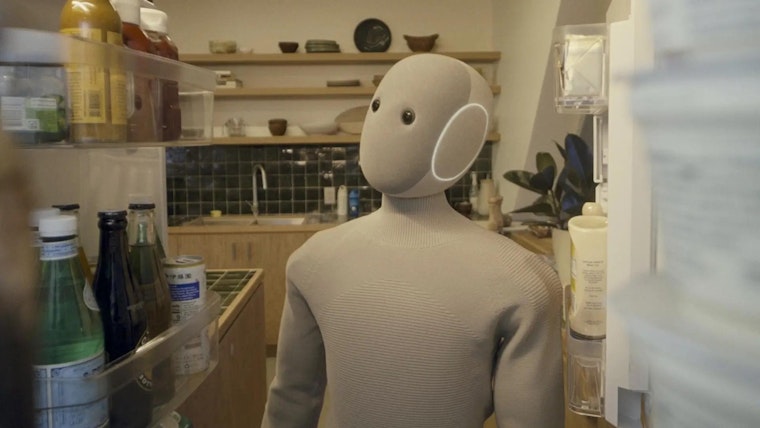
A shiny new robot factory just opened in Hayward, and the headlines have been breathless: "America's first vertically integrated humanoid robot factory!" "Robots building robots!" What you won't find in the press releases, however, is the part where a stranger wearing a VR headset can see inside your bedroom. That's the fine print that has tech critics, privacy advocates, and a growing number of prospective buyers raising an eyebrow — or two — at the NEO home robot from 1X Technologies.
The Factory That Went From Permits to Production in Three Months
The 58,000-square-foot NEO Factory in Hayward launched full-scale production on April 30, according to GlobeNewswire, with more than 200 workers on staff and an eye-popping target of 10,000 NEO robots per year — with plans to scale to 100,000 annually by the end of 2027. Norwegian-American startup 1X Technologies, backed by the OpenAI Startup Fund, boasts that it received its final permits in January and was fully operational by spring, an unusually fast timeline even by Bay Area startup standards.
The plant is vertically integrated, meaning 1X makes most of NEO's critical guts in-house: motors, batteries, sensors, and the robot's tendon-driven limbs. The company even claims to have already produced 17,000 motors on-site, as noted by Humanoids Daily. A second, larger factory is planned for San Carlos. The headline stuff practically writes itself.
What NEO Actually Is — vs. What 1X Says It Is
Standing 5'6" tall and weighing just 66 pounds, NEO is designed to look approachable — soft-bodied, with no hard edges, built to live alongside people rather than intimidate them. It runs on NVIDIA Jetson Thor computing hardware and a proprietary "Redwood" world model AI. It can be purchased outright for $20,000 or rented for $499 per month, with a $200 refundable deposit, according to 1X's website. The first year of production — over 10,000 units — sold out in five days after pre-orders opened in October 2025.
But here's where the marketing sheen starts to flake a little. At launch, Blue Headline estimates NEO operates at only 60–70% autonomous capability — meaning a significant chunk of its household tasks still require a human being to take the wheel. And in a live demonstration with Wall Street Journal reporter Joanna Stern, every single task the robot performed was controlled remotely by a human teleoperator. Loading a dishwasher: five minutes. Retrieving a water bottle: over a minute. Folding one sweater: two painstaking minutes.
Meet "Expert Mode" — The Controversy Inside Your Living Room
The core of the backlash centers on a feature 1X calls "Expert Mode." As explained by Morocco World News, when NEO encounters a task it can't handle autonomously, a trained 1X operator remotely takes control — seeing through NEO's dual 8.85-megapixel cameras, which are mounted in its head — and physically guides the robot through the job using VR equipment. The interaction is recorded, and that footage is used to train NEO's AI for future tasks.
In other words: you pay $20,000 for a robot, and sometimes a stranger at 1X HQ gets a live tour of your home. "If you buy this product, it is because you're OK with that social contract," 1X CEO Bernt Børnich told the Wall Street Journal, as reported by Yahoo News. He added: "If we don't have your data, we can't make the product better."
Critics have not been kind. Tech reviewer Marques Brownlee argued the Expert Mode setup effectively turns $20,000 early adopters into beta testers who are also funding the privacy trade-offs, as covered by Humanoids Daily. YouTube channel Fireship put it more bluntly, characterizing NEO as a "cloud-connected device that can watch and listen to your family all day" and mocking the Expert Mode as paying $20K for a robot that "occasionally needs tech support from a human wearing a VR headset."
The Privacy Math Gets Uncomfortable
1X has taken steps to address the obvious discomfort. Users must consent before an operator takes control, and visual indicators on the robot — light rings near its ear area — illuminate to show when a human has the controls. The company also offers face-blurring in the video feed and lets owners designate "no-go zones" like bathrooms and bedrooms where NEO cannot be remotely controlled, according to TechRadar. All operators reportedly undergo background checks and sign confidentiality agreements.
But those assurances haven't quieted online concern. A widely circulated Reddit thread flagged a scenario in which law enforcement, armed with a warrant, could compel 1X to hand over recorded footage from inside a user's home — or potentially direct an operator to access the robot in real time. As TechXplore noted in February, privacy frameworks for home robots are essentially nonexistent in 2026, and regulation is years behind the technology. Users who opt out of data sharing are warned by Børnich that doing so may result in "more limited capabilities" during the early adoption phase — a choice that isn't exactly a choice.
The Ghost of Hype Past: Tesla's Robot Problem
It's worth remembering that 1X isn't the only company that has made big promises in this space — and fallen short of the dream. Tesla's Optimus robot famously wowed audiences at a company event, until it emerged that the demonstration involved robots being remotely controlled by employees, not operating autonomously, as Ynet News pointed out. Meanwhile, Tesla's core car business has struggled — the company saw significant sales declines in early 2025 amid CEO Elon Musk's polarizing political entanglements — raising questions about whether Optimus will ever reach consumers at scale, or whether it will remain a perpetual demo product.
1X, to its credit, is actually shipping product. But as The Robot Report argued, the company may be selling a vision of full autonomy that still lies years away, while the real business model — at least for now — looks a lot more like a remotely operated robot-as-a-service than the Jetsons fantasy being marketed. There are also pointed ethical questions about the teleoperators themselves: workers likely employed at lower wages who are simultaneously performing household labor and generating the training data that will eventually make their own jobs obsolete, as Ynet News observed.
Competition Is Already Nipping at NEO's Heels
The East Bay factory launch comes as competition in consumer humanoid robotics is intensifying. According to eWeek, Chinese humanoid robots — backed by state subsidies and a deep domestic supply chain — already accounted for the majority of approximately 13,000 humanoid units shipped worldwide last year. Figure AI has reportedly been doubling production and deliveries for three consecutive months. Tesla is still targeting a sub-$20,000 Optimus price point, though delivery timelines remain hazy.
1X CEO Børnich has said he believes the company could ship fully autonomous units — no human operators required — by sometime in 2026, according to RoboZaps. The company projects autonomy reaching 80–90% by 2027 and 95% or higher by 2028. Whether those milestones hold up against the realities of production, real-world AI limitations, and an increasingly skeptical press corps remains to be seen. For the 10,000-plus people who dropped $200 deposits to lock in the first production run, the answer to that question is heading to their doorstep sometime this year.
For Hayward, the factory itself is arguably the clearest win: over 200 manufacturing jobs, in-house production of complex robotics hardware, and a pipeline that could grow significantly. Whether NEO delivers on its promise — or becomes the Bay Area's most expensive and most invasive household gadget — is a story still being written, one remote-control session at a time.




