

























































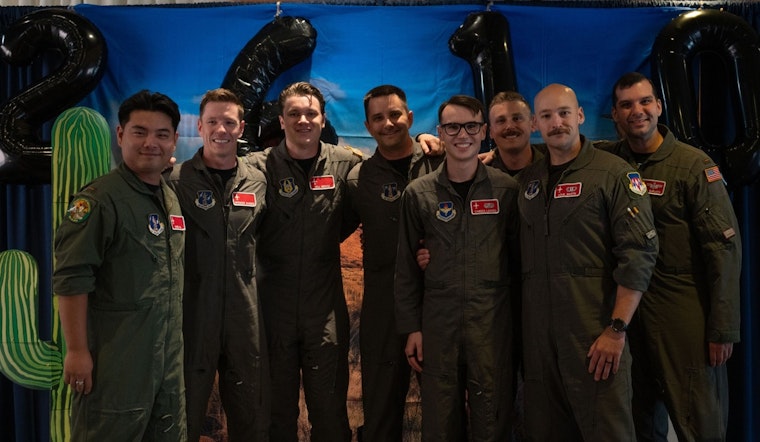
After roughly 30 years of advanced flight training on the twin-engine T-1A Jayhawk, Vance Air Force Base has officially called it a wrap. On Thursday, the final group of student pilots in Enid finished the T-1 syllabus, closing out live-jet instruction in that aircraft as the Air Force leans harder on simulators and a revamped undergraduate pilot training model.
Farewell In Enid
According to KFOR, base officials marked the milestone with a sendoff for the last T-1A class, a group of 10 student pilots. The spotlight fell on 2nd Lt. Camden Larsen, recognized as the final active-duty T-1 student pilot. Photos from the event, credited to the Vance AFB Facebook page, show a ceremony that felt more like a planned handoff than a sudden shutdown, with leaders emphasizing that this was a long-anticipated transition.
Simulators And The Future Of UPT
Air Education and Training Command has been steadily pulling the Jayhawk from its training inventory and replacing portions of that syllabus with simulator-heavy instruction, according to AETC. The plan is to move students into advanced simulators such as the T-96, which are built to mirror the Jayhawk’s mobility mission set while cutting down on weather delays and maintenance demands. The shift lines up with the Air Force’s broader effort to modernize how it conducts undergraduate pilot training.
What This Means At Vance
Even without the Jayhawk on the ramp, Vance will remain a primary hub for Undergraduate Pilot Training, and base officials say they intend to use lessons from FUPT to keep pilot production on track, according to Vance AFB. Strong sortie-generation numbers in recent years have positioned the 71st Flying Training Wing to absorb the new syllabi without slowing the flow of newly winged pilots. Students bound for airlift and tanker pipelines will still get mission-specific preparation, although more of that work will take place in front of simulator screens instead of T-1 cockpits.
A Long Run In The Sky And A Planned Retirement
The T-1A has served as a workhorse for mobility and tanker training since the early 1990s, helping shape generations of Air Force aviators at locations that included Vance. AF.mil outlines the Jayhawk’s background and role in the training pipeline, while official FY2026 force-structure documents identify the aircraft’s divestment as part of the Pentagon’s larger modernization push. Taken together, those records make clear that the decision to retire the T-1A is a department-level move, not a one-off adjustment by a single base.
Continuity For The Training Mission
Officials say the transition is structured to keep pilot production steady even as the method of delivery changes, with training scheduled to continue without interruption while students shift into updated curricula and more simulator time, according to AETC. In Enid and across the 71st Flying Training Wing, the final Jayhawk class served as both a modest ceremony and a clear signal that pilot training is entering a new phase of simulators and revised course outlines. Community members and military families turned out for the low-key farewell, which base leaders repeatedly described as a deliberate, planned transition rather than an abrupt end.





