

























































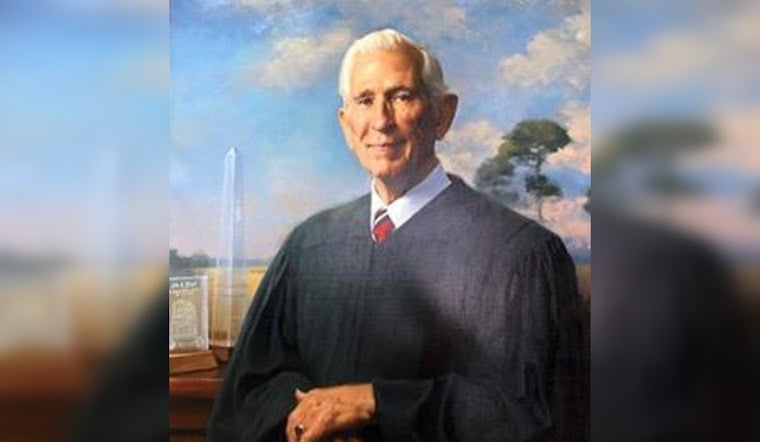
Judge James Lawrence King, one of South Florida’s longest-serving federal jurists, died Saturday at his home in Pinecrest. He was 98. Known for an iron-man work ethic and a steady hand on some of the region’s highest-profile prosecutions and civil rulings, King left an indelible mark on Miami’s courts, including on a downtown federal building that now carries his name.
According to Miami Herald, King presided over landmark prosecutions ranging from the Court Broom corruption cases to major Colombian cartel trials and litigation tied to Cuba’s shootdown of Brothers to the Rescue planes. The Herald reported he authored more than 1,020 decisions and sentenced over 6,000 defendants during a bench career that stretched more than five decades. His children provided a statement to the paper remembering him as “a giant in the South Florida legal community” and noting the family’s devotion to the simple life. Prominent trial lawyers also praised his fairness and rigor, with one calling him “a legend.”
Long Tenure, Notable Rulings
Born Dec. 20, 1927, King earned his law degree from the University of Florida and served as a first lieutenant in the U.S. Air Force JAG during the Korean War. The Federal Judicial Center records show he was nominated to the U.S. District Court for the Southern District of Florida in October 1970, served as chief judge from 1984 to 1991, and assumed senior status on Dec. 20, 1992.
Honors and the Courthouse
King received the 18th Annual Edward J. Devitt Distinguished Service to Justice Award in 2000, as noted by The Florida Bar. At that ceremony, Supreme Court Justice Ruth Bader Ginsburg called him “the front-runner from the start,” the Miami Herald reports. Congress renamed the downtown federal building the James Lawrence King Federal Justice Building in 1996, per the Southern District of Florida.
Colleagues said King set a standard for preparation and decisiveness in a district that handles some of the country’s most consequential trials. He will be remembered as a defining figure in South Florida’s federal judiciary whose decisions shaped local law and its national reputation.




