

























































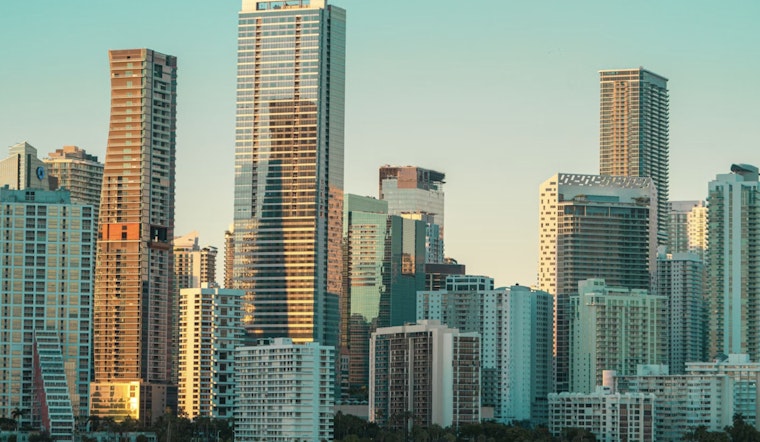
Two Miami insiders are sounding the alarm on the city’s vertical boom, warning that some of its sleek new waterfront towers may be sinking into soft, uneven ground faster than expected and urging officials to hit pause on fresh approvals.
University of Miami engineering professor Jean‑Pierre Bardet and Edgewater resident Jeffrey Dorfman argue in a newly released paper that the city should not greenlight more high-rises along Biscayne Bay without tougher rules. They want site-specific geotechnical testing on every project, mandatory long-term monitoring of how buildings settle and stronger financial guarantees from builders before the next luxury tower pierces the skyline.
Their paper, published Wednesday in the Journal of Critical Infrastructure Policy, calls for a temporary moratorium on new high-rise permits and the creation of an independent panel to scrutinize proposals, according to the Miami Herald. Bardet and Dorfman also propose a developer-funded pool that would keep 40-year structural-performance liability on builders instead of shifting it to unit owners, insurers or taxpayers.
Satellite Observations Show Rapid Subsidence
The safety worries are not just gut feelings. A 2024 InSAR satellite study led by University of Miami researchers found widespread coastal subsidence on Miami’s barrier islands, with vertical movement reaching about 8 centimeters in some spots between 2016 and 2023, and linked many of those signals to recent construction activity, according to the University of Miami.
The team says the satellite data flags settlement hotspots in Sunny Isles and Surfside and shows that ground movement can be faster and more uneven than traditional geotechnical models typically assume.
Why Geotech Matters
Miami’s subsurface is not exactly a solid rock pedestal. It is a patchwork of porous limestone, sand and shallow water tables, a recipe that makes differential settlement, where one part of a foundation sinks faster than another, a genuine concern for today’s tall, slender towers.
National reporting has identified roughly three dozen beachfront and bayfront buildings that show measurable settlement, a finding that has helped trigger sharper scrutiny of new construction, according to AP News. Engineers warn that smaller building footprints concentrate loads and can magnify settlement risks if foundations are not designed conservatively.
What The Researchers Are Watching
“I see a new phenomenon, something that we did not know before, and I’m trying to understand it,” Bardet told the Miami Herald, arguing that the findings call for more conservative foundation designs and long-term monitoring of how towers behave over decades.
He and Dorfman say the current approval framework, including mechanisms that let developers buy extra height without fully accounting for lot-by-lot subsoil differences, effectively underprices the geotechnical risk baked into each site.
Policy And Legal Fallout
The authors also take aim at recent state-level changes that shortened Florida’s statute of repose for construction-defect claims from 10 years to seven, saying the shift weakens developer accountability for settlement problems that take time to show up. The change and related legislative materials appear in Florida Senate committee documents and post-Surfside reform summaries, per the Florida Senate.
Owners Are Already Suing
For Bardet and Dorfman, early cracks in the system are not theoretical. Litigation over new towers is already moving through the courts, which they say suggests that existing permitting rules may be missing key risks.
One example: the homeowners’ association at Missoni Baia, which has accused the project of numerous construction defects, including cracking and water intrusion, in a recent lawsuit reported by Commercial Observer.
What Comes Next
Bardet and Dorfman insist they are not trying to freeze Miami’s skyline in place forever. They say they hope their paper spurs more scientific research and targeted policy changes, not a permanent development ban, and they are planning follow-up work to better define where and how tall buildings can safely rise on Miami’s challenging soils.
For now, city officials, developers and engineers have a choice to make: whether to adopt the site-specific testing, monitoring programs and financial sureties the paper lays out before signing off on the next wave of glassy waterfront towers.





