

























































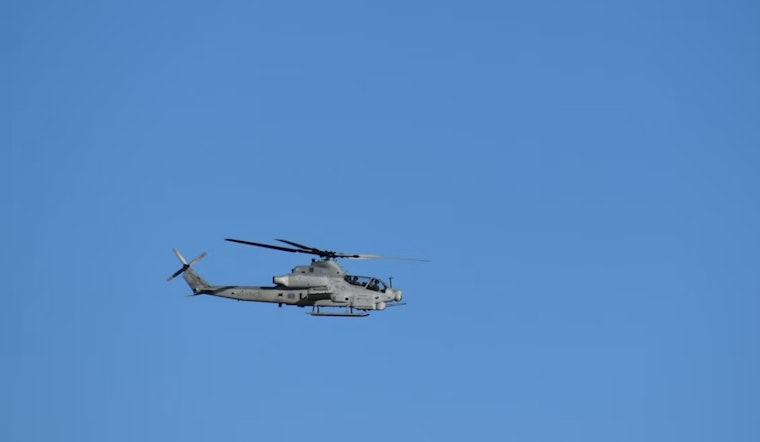
Out in the desert near Twentynine Palms last Wednesday, Miramar-based Marines took a big step into the drone-heavy future of combat, turning their UH-1Y Venom and AH-1Z Viper helicopters into airborne "motherships" for small, strike-capable first-person-view drones. In the demonstration, a Neros Archer FPV drone launched from the ground, then was taken over mid-flight by a UH-1Y crew, showing how cheap, expendable drones can stretch a helicopter’s reach while keeping aircrews farther from danger.
According to the Times of San Diego, the Marine Corps called the event, which involved both UH-1Y reconnaissance helicopters and AH-1Z gunships, a significant leap forward for aerial warfare. The Corps views the mothership concept as a scalable, relatively low-cost way to counter threats without burning through high-end munitions or exposing helicopter crews more than necessary.
In its own detailed breakdown, the Marine Corps notes that units from Marine Light Attack Helicopter Squadron (HMLA)-169, Marine Air Group-39, and the 3rd Light Armored Reconnaissance Battalion participated in the drill. Ground Marines launched the Neros Archer, then seamlessly handed off control to operators inside a UH-1Y. In the DVIDS account, Capt. Quinton Thornbury said the aim was to test the feasibility of a non-kinetic drop and deployment of a first-person view drone from a moving helicopter, with the Venom acting as a flying command post to steer the drone toward its target.
How the mothership handoff actually worked
The concept blended old-school air support with new-school unmanned tactics. A ground team first launched the Archer FPV, then once it climbed out, the helicopter crew took control from the air. With the advantage of altitude and mobility, the UH-1Y could push the drone deeper into contested airspace than a purely ground-controlled system. The Times of San Diego reports that this setup lets helicopters hold safer standoff distances from layered air defenses while still conducting precision strikes with small, expendable systems.
Why the Marines are accelerating FPV adoption
Marine leaders say the approach keeps the H-1 helicopter fleet relevant while giving commanders a flexible, budget-friendly strike option. “We are still providing our ground support, and close air support, but in a way that lets the drones close with and destroy the enemy, rather than putting our Marines in harm’s way,” Sgt. Matthew Pocklington said in the Marine Corps write-up of the test, also published via DVIDS.
The rapid shift toward FPV systems reflects hard lessons from the war in Ukraine, where first-person-view and loitering munitions have reshaped how units scout and strike along the front. Reporting by The Washington Post details how relatively cheap, difficult-to-stop FPV drones have forced militaries to rethink both tactics and what they buy.
The Archer platform itself has scaled quickly, with industry moves helping it get into Marine hands sooner rather than later. Company statements and coverage note that Neros has secured contracts to supply Archer FPV systems to the Marine Corps and to overseas partners, speeding their integration into training and live exercises. Business Wire reports on the contracts and early operational use that have driven that fast rollout.
For San Diego residents, this is a familiar storyline. Marine Corps Air Station Miramar and nearby ranges, including the Marine Corps Air Ground Combat Center at Twentynine Palms, are increasingly being used as testbeds for new aviation and unmanned tactics that may later spread across the service. Communications from MCAS Miramar and the related DVIDS coverage indicate that testing will continue as the Corps refines procedures, training and command-and-control links for mixed crews of pilots and drone operators.
The Miramar trials do not solve the broader headaches of counter-drone threats and electronic warfare, but they make clear how the Corps plans to bolt modern, expendable systems onto legacy airframes to keep them lethal while lowering risk to pilots and helicopters. Expect more live-fire experiments and updated doctrine as Marines push FPV drone tactics deeper into their maneuver units.





