

























































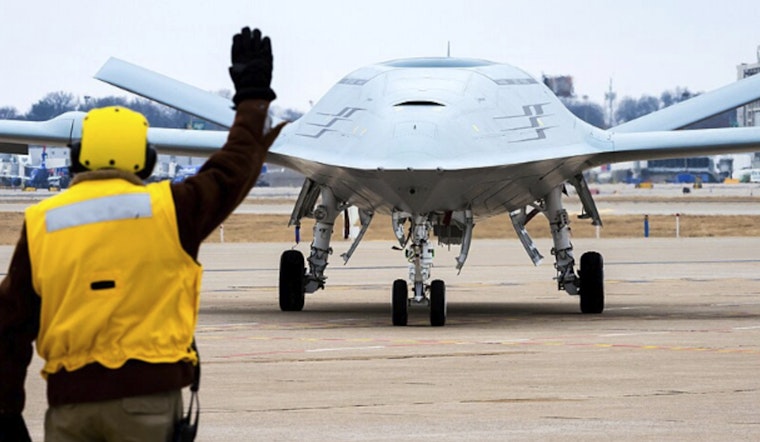
The Navy’s future drone tanker just logged a major milestone over Metro East. Boeing and the U.S. Navy flew the MQ-25A Stingray from MidAmerica St. Louis Airport in Mascoutah on April 25 in a roughly two-hour test that company officials say validated the unmanned refueler’s flight controls. The production-representative aircraft autonomously taxied, took off, executed a mission profile and landed during the sortie, marking a key moment for a program designed to extend carrier air wing range. For Metro East residents, the flight was the clearest sign yet that Boeing’s new Mascoutah assembly line is shifting from pure construction to turning out hardware that is expected to fly off U.S. carriers.
What Boeing and the Navy Said
During the two-hour sortie, the MQ-25 used the Unmanned Carrier Aviation Mission Control System MD-5 ground station to execute its mission, demonstrating autonomous functions with human oversight, according to Boeing. Company statements described the flight as a major maturation step for the program, while Navy officials cast the milestone as progress toward folding an unmanned tanker into the carrier air wing.
Why the Metro East Matters
The MQ-25 program has effectively anchored a new aerospace footprint at MidAmerica. The Navy’s program of record currently estimates roughly 76 aircraft, including both operational and test airframes, according to the Congressional Research Service. Local reporting and airport materials also note that the Mascoutah plant will handle final assembly and could support hundreds of jobs, and regional coverage has put the buildout at up to about 300 employees as production ramps, per the Illinois Business Journal.
Testing Timeline And Next Steps
Boeing says additional validation flights will continue out of MidAmerica before the aircraft transitions to Naval Air Station Patuxent River in Maryland to prepare for carrier qualifications. Independent reporting has also noted that the program’s schedule has slipped in recent years and that carrier integration and initial operational capability may extend later into the decade, according to DefenseOne.
Local Reaction And Jobs
Regional leaders and manufacturing groups say the MQ-25 line could draw suppliers and training programs into the Metro East supply chain, expanding a local defense ecosystem that was already scaling up. Reporting on how St. Louis drone makers scramble to meet Pentagon demand has documented the broader buildout, and state and local officials have pointed to the Mascoutah plant as a major recruiting and workforce-development opportunity for the region.
The next milestones to watch are additional flight tests, any official low-rate initial production decisions and the start of formal carrier-qualification testing. All of those will help determine how quickly Mascoutah’s factory scales and how many more suppliers and jobs arrive in Metro East, as outlined by the Congressional Research Service. For local businesses and workers, those calendar moves will shape when assembly lines expand and when secondary firms start hiring.





