

























































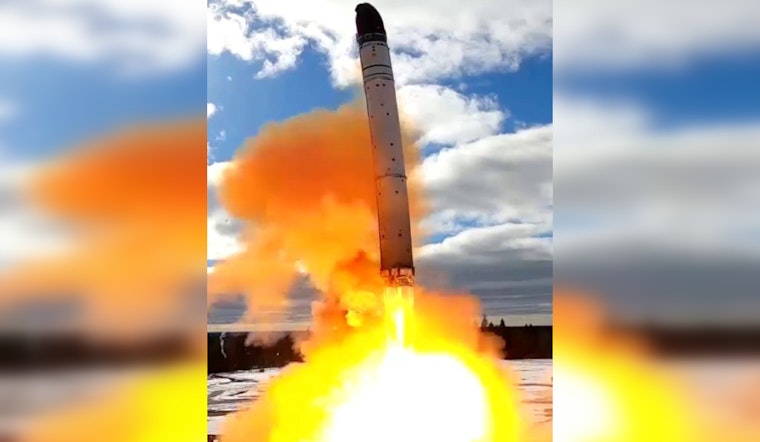
Russia on Tuesday said it had successfully test-fired its RS-28 Sarmat intercontinental ballistic missile, the system NATO nicknames "Satan II," in a launch President Vladimir Putin hailed as proof that Moscow fields the most powerful missile on the planet. Putin announced that the weapon would be placed on combat duty by the end of the year and cast the test as a key milestone in upgrading Russia’s nuclear arsenal. The show of force came as Moscow marked a scaled-back Victory Day, one that, for the first time in nearly two decades, left heavy military hardware off Red Square.
What Russian officials said
Sergei Karakayev, commander of Russia's Strategic Missile Forces, told Putin that the Sarmat was launched from the Plesetsk Cosmodrome and hit a designated impact zone at the Kura test range, according to The Barents Observer. Russian state television showed Karakayev briefing the president over a video link, with Putin calling the flight a "major event and unconditional success" as he listened to the rundown of the launch.
Putin's claim
"This is the most powerful missile in the world," Putin declared after the test, insisting that the combined warhead yield of Sarmat is "more than four times" that of its Western counterparts and claiming the missile can fly on suborbital trajectories designed to slip past missile defenses, according to AP. He reiterated that the system is slated to go on combat duty before the end of the year and framed the launch as a critical step in the overhaul of Russia's strategic nuclear forces.
What the missile is
Independent analysts classify the RS-28 Sarmat as a "super-heavy" liquid-fueled intercontinental ballistic missile with an estimated throw weight of about 10,000 kilograms, capable of carrying multiple independently targetable reentry vehicles, known as MIRVs, or hypersonic boost-glide vehicles, according to CSIS Missile Threat. The development effort dates back more than a decade and was formalized through production contracts in the early 2010s, a schedule that has been stretched by years of delays.
A troubled test history
Those delays have come with visible problems. Satellite imagery and open-source analysts documented a major failure at the Plesetsk launch complex in September 2024 that left a sizable crater and damaged nearby infrastructure, a setback that raised fresh questions about the missile's reliability, according to The Moscow Times. Before the most recent launch, the Sarmat program had only one widely acknowledged full-flight success, in April 2022, which is why repeated tests are seen as essential for proving the design.
Arms-control backdrop
The new test comes after the last binding arms control agreement between Washington and Moscow, the New START treaty, expired on Feb. 5, 2026, removing formal limits on deployed strategic nuclear forces, according to CBS News. Estimates from the Federation of American Scientists indicate that Russia and the United States still control the vast majority of the world’s nuclear warheads, with roughly 4,400 in Russia's military stockpile and about 3,700 in the U.S. stockpile, which is why any decision to deploy a new heavy ICBM lands with global weight.
Why Washington is watching
A missile with Sarmat's throw weight and claimed flexible flight paths would complicate missile-defense planning and could let Moscow pack more destructive power onto fewer launchers. That combination is a big part of why U.S. and NATO intelligence agencies are closely scrutinizing the flight data and any changes at Russian basing sites. Outside experts caution that public Russian statements about the missile's range and yield are hard to verify independently and have sometimes been exaggerated; technical specialists at CSIS Missile Threat and other research groups say independently gathered telemetry or tracking data will be crucial in judging the real performance.
What’s next
Moscow says it plans to place the first Sarmat regiments on combat duty before the end of 2026, a schedule that would nudge Western capitals toward their own mix of intelligence work, policy responses and possible new deterrence measures, according to AP. For now, officials and analysts are focused on independently validating the latest test data and watching to see whether the Kremlin actually follows through with force-structure changes that would meaningfully shift the strategic balance.



