

























































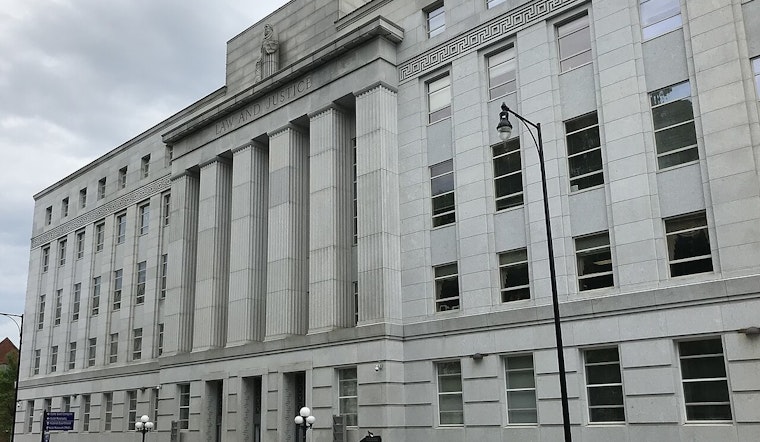
In North Carolina's running tug-of-war between judicial decorum and free speech, Supreme Court Justice Phil Berger Jr. is pushing to loosen the reins on what judges can say about politics.
Berger circulated a proposal by email to his colleagues in December 2025, arguing that current limits on judges' political speech are too subjective and risk being weaponized against them. He described the plan as an effort to protect constitutionally protected speech while still keeping courtrooms fair.
Berger gave permission for the email to be made public, and the full text was posted online, according to the John Locke Foundation. The group reproduced his proposed amendment and noted that he pointed to the U.S. Supreme Court's 2002 decision in Republican Party of Minnesota v. White as a key legal reference.
What Berger wants to change
Under Berger's draft, the Judicial Standards Commission would be barred from disciplining judges for any speech that is constitutionally protected. The commission could still act if a judge revealed confidential court information or commented on the merits of a pending case. The plan would also prohibit judges from making "knowingly false statements concerning the qualifications or integrity" of other judges or judicial candidates. Berger has pitched the shift as an attempt to create clearer, more objective enforcement rules, as reported by The News & Observer.
"My preference would be that judges and justices refrain from discussion of political issues," Berger wrote. He warned that vague standards around political speech invite uneven enforcement, according to The News & Observer. On its face, the proposal does not change the existing rule that bars judges from endorsing candidates when they are not themselves running for office.
Context: Earls, the JSC and past disputes
Berger's push comes after a high-profile clash between the Judicial Standards Commission and Democratic Justice Anita Earls. In 2023, the commission investigated Earls over her public comments about diversity on the bench. Earls later withdrew a federal lawsuit she had filed against the commission after the investigation was dropped, as reported by AP. The episode, along with coverage of internal memos and charging decisions, sharpened scrutiny of how aggressively the commission can police judges' public remarks.
Legal implications
Berger's email explicitly cites the U.S. Supreme Court's ruling in Republican Party of Minnesota v. White, which restricted how far states can go in banning judicial candidates from expressing views on disputed political or legal issues. Legal commentators have pointed to that case as the constitutional backdrop for Berger's argument, according to Justia. If the North Carolina Supreme Court decided to revise the Code of Judicial Conduct to align more closely with that reasoning, it could narrow the Judicial Standards Commission's enforcement options in politically sensitive cases.
The court already has statutory authority to set standards for judicial conduct. That power is spelled out in N.C. Gen. Stat. § 7A-10.1.
Any formal change, however, would still require the Supreme Court to adopt an amendment to the Code, and that process has not been publicly launched. The current North Carolina Code of Judicial Conduct instructs judges to behave in ways that "promote public confidence in the integrity and impartiality of the judiciary," as set out by the court's code document on N.C. Courts. For now, that leaves the balance between free speech and perceived impartiality as a live question for the state's highest court.





