

























































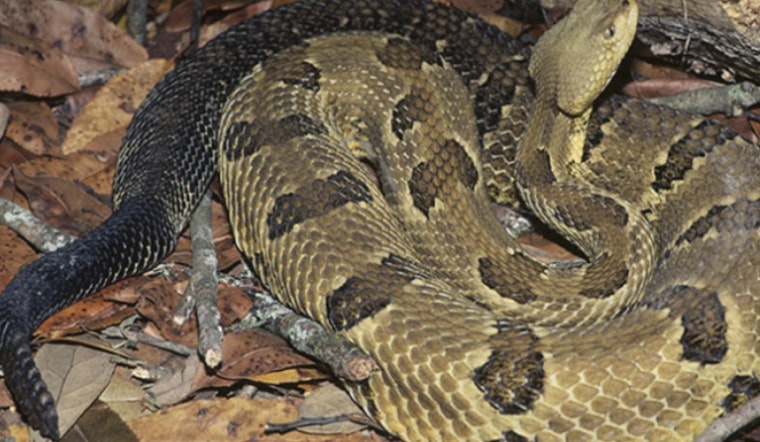
Along the tight five-mile squeeze of Interstate 40 through the Pigeon River Gorge, rattlesnakes have become just another item on the daily safety checklist. About 300 people are working to rebuild the eastbound lanes that Hurricane Helene wiped out, and crews say they are spotting at least one timber rattlesnake every day, although no one on the job has been bitten so far.
Snakes Are Part Of The Workday
Anyone stepping onto the I-40 worksite gets a yellow safety vest and an extra warning: watch your feet. Crews say that equipment, piles of debris and anything left sitting on the ground for a while can turn into snake real estate. Resident engineer Blake Soblesky told reporters that when they lift items that have been there a few weeks, they often find rattlers underneath, explaining, “Items laying on the ground that have been there a few weeks, you pull that up, there they are.” As reported by the Raleigh News & Observer, timber rattlesnakes sometimes bask in the sun or sound off with a rattle when disturbed.
How Crews Manage The Risk
Engineers describe the Pigeon River Gorge rebuild as one of the largest uses of roller-compacted concrete in the country, part of an approximately $2 billion push to make I-40 tougher against future storms. Around 300 workers are on site now, with staffing expected to grow to roughly 500 this summer, and the work is slated to continue through fall 2028. Crews are installing long retaining walls, hauling rock from nearby Pisgah National Forest and keeping traffic squeezed to a single lane in each direction to balance safety and access, according to reporting from WUNC News.
Timber Rattlesnake Basics
The timber rattlesnake (Crotalus horridus) is an ambush predator that feeds mostly on rodents and typically wants nothing to do with people. State wildlife officials note that the species can be heavy-bodied and stretch several feet in length, and that its hemotoxic venom can cause serious local tissue damage or broader systemic effects, so any bite is treated as a medical concern. For species details, how to report sightings and what to do if someone is bitten, see the North Carolina Wildlife Resources Commission and NC Poison Control.
Construction And Conservation Collide
Because this stretch of I-40 runs between Great Smoky Mountains National Park and Pisgah National Forest, planners are constantly weighing construction speed, driver safety and wildlife protection. Contractors and designers have built in wildlife-friendly features such as bat roosts and have coordinated with local conservation groups working on “Safe Passage” strategies to reduce animal-vehicle collisions. The schedule is structured under collaborative delivery models meant to move the project faster while lining up environmental mitigation, as described by Kiewit and Safe Passage.
Drivers threading through the gorge should be ready for narrowed lanes, slimmed-down shoulders and a 35 mph speed limit, and anyone entering the work zone is expected to follow posted signs and on-site staff instructions. The N.C. Department of Transportation says the temporary traffic pattern and warning systems are designed to keep both people and wildlife as safe as possible while the rebuild continues, as outlined by the N.C. Department of Transportation.





