

























































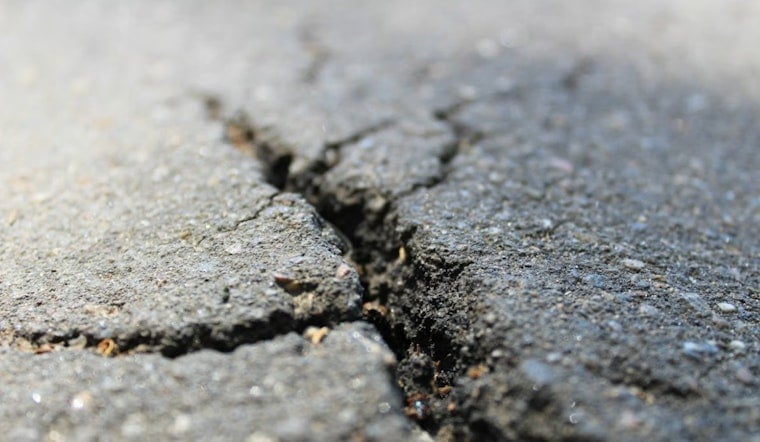
For many San Diegans, earthquake danger lives somewhere far off along the San Andreas. In reality, a far less famous fault, the Rose Canyon Fault, cuts straight through the city, running beneath downtown, the convention center and up through Mt. Soledad in La Jolla. Geologists say it is very much an active hazard, and that gaps in detailed mapping leave nagging questions about exactly which streets, homes and big-ticket projects sit on or near its buried strands.
A major fault right where you live
The Rose Canyon Fault is part of the larger Newport‑Inglewood–Rose Canyon system and comes ashore at La Jolla before angling across the city toward San Diego Bay, according to the U.S. Geological Survey. The agency notes that portions of the fault show Holocene activity and that decades of urban growth have obscured many of the visible traces at the surface, making some strands tough to pin down with standard mapping tools.
That kind of technical fine print, including estimated slip rates of roughly 1 to 1.5 millimeters per year, is exactly why seismologists treat Rose Canyon as a standing local threat instead of a geological fun fact.
Local geologists say the public isn't aware
“When I teach about earthquakes, I pull up a map,” geology instructor Tina Zeidan told her students as she pointed out the line that runs under the convention center and up through Mt. Soledad. “No one,” she added, “not one student in my 11 years of teaching, knows,” according to the Times of San Diego.
San Diego City College geologist Lisa Chaddock has similarly warned that the public’s near-obsession with the San Andreas can blur awareness of closer, more immediate risks. She has also noted that limited fault mapping under dense development makes planning and permitting far trickier for busy downtown sites.
Fault Line Park: an art piece with a lesson
In East Village, Fault Line Park literally draws one strand of Rose Canyon on the ground. A concrete walkway tracks the fault’s path, while two mirrored spheres let visitors “see” how the ground has shifted since the artwork was put in, as described by the City of San Diego's arts office. The public space, and its “Fault Whisper” installation that turns seismic signals into sound, opened in 2015, as covered by KPBS.
The park is small, almost understated, but the point is not: the fault does not stay politely out on the cliffs. It slices through streets, foundations and new towers.
Hidden strands reshuffle development plans
Developers breaking ground downtown have repeatedly found more than old utility lines. Heavy equipment has uncovered faulting or triggered extra trenching and redesigns, according to regional planning documents. Environmental reviews and technical guidance from the San Diego Association of Governments detail the added costs, delays and specialized geotechnical studies that tend to follow when previously unmapped strands turn up mid-project.
All of that helps explain why local geologists and planners are increasingly urging a cautious, eyes-open approach whenever big digs happen in the urban core.
Why now: swarms and new science
Last week’s seismic swarm near Brawley in Imperial County, a burst of dozens of small earthquakes and a few in the mid-magnitude range, was a fresh reminder that Southern California faults can wake up on their own schedule, as reported by the Los Angeles Times.
The U.S. Geological Survey has also released scenario modeling for a magnitude 6.9 rupture on Rose Canyon, simulating how ground shaking could play out across downtown and coastal neighborhoods; the scale of those possible effects is captured in an U.S. Geological Survey animation. Together, the recent swarm and the modeling keep Rose Canyon on the radar for scientists and emergency officials.
What locals should do
The basics of earthquake preparedness do not change just because the nearest active fault turns out to be hiding under your commute. Residents are advised to secure heavy shelves, assemble a 72-hour emergency kit, learn how to shut off utilities and practice “Drop, Cover, Hold On,” according to the Earthquake Country Alliance.
Local emergency-management pages and regional planners also publish checklists and retrofit guidance. For new or proposed downtown projects, community members are encouraged, in planning documents from the San Diego Association of Governments, to ask developers and the city about recent site-specific fault studies or geotechnical reports before construction moves too far along.
That mix of personal readiness and public scrutiny may be the most practical defense against a fault line that, for many San Diegans, is still hiding in plain sight.



