

























































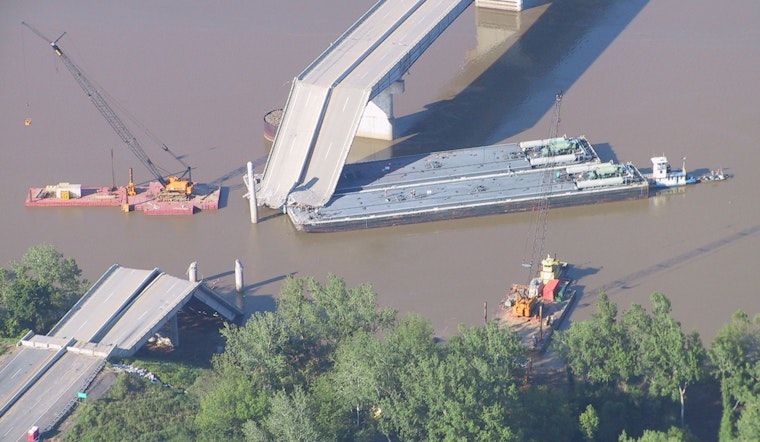
Twenty-four years after a barge slammed into the I-40 bridge near Webbers Falls and dropped a 503-foot stretch of highway into the Arkansas River, the town is again pausing to remember. Fourteen people were killed on May 26, 2002, and eleven others were injured when passenger cars and tractor-trailers plunged into the river or onto shattered concrete. For people in Webbers Falls and nearby river towns, the noise, the confusion and the sight of broken roadway hanging over the water have not faded much with time.
NTSB Findings
The National Transportation Safety Board ultimately traced the disaster to the towboat Robert Y. Love, which veered out of the navigation channel after its captain suffered a medical emergency and lost consciousness. The drifting barges hit a bridge pier, the report found, snapping away a 503-foot span and sending vehicles over the edge. In its final Highway and Marine Accident Report, the NTSB laid out a detailed reconstruction of the collision and followed it with safety recommendations meant to strengthen vessel monitoring and bridge protection around the country.
Replacement Work Begins
As the 24th anniversary is marked, local outlets are noting that construction crews are starting the long-awaited full replacement of the I-40 bridge near Webbers Falls. Coverage from KOCO revisits harrowing scenes from the 2002 rescue and recovery effort and reports that replacement activity is moving forward this year. According to the Oklahoma Department of Transportation, the project is part of an I-40 and SH-100 bridge-replacement bundle that also funds preliminary engineering and a vessel-collision study for the crossing.
Rebuilding Then And The Local Memorial
The Federal Highway Administration later held up the I-40 rebuild as an example of how fast a route can come back when federal, state and private partners all pull in the same direction. Local reporting notes that the bridge reopened in just over two months, a pace that would make most road projects today look sluggish. On the riverbank, memorial markers now give families, survivors and first responders a place to gather each year, a ritual that has been documented in anniversary coverage from KRMG.
Safety Legacy
The NTSB used what it learned in Webbers Falls to push for stronger defenses against barge and vessel strikes. Its recommendations called for better fender systems around bridge piers, improved ways to track and monitor vessels, and motorist warning systems that can stop traffic if a span is compromised. Those proposals have helped shape later bridge-protection work, including ODOT’s vessel collision study for the I-40 replacement project, which looks at navigation hazards on the river and how to reduce them.
Memories That Linger
In one of the starkest recollections from that morning, an unnamed witness told KOCO he saw "a lot of diapers and car seats" drifting downstream, a detail survivors say still surfaces at memorials. Local TV archives keep returning to the story, and anniversary pieces have preserved interviews with people who crawled out of the wreckage and first responders who worked on the water, as seen in coverage by 4029.
As crews gear up to swap out the aging span for a modern structure, the anniversary is pulling double duty. It is a reminder of the 14 lives lost in a matter of seconds, and a quiet test of whether two decades of promised lessons are fully showing up in new bridge designs and navigation safeguards. Along the river, the memorial site remains a low-key place where families and first responders leave flowers, trade stories and make sure the people they lost on I-40 are still called by name.



