

























































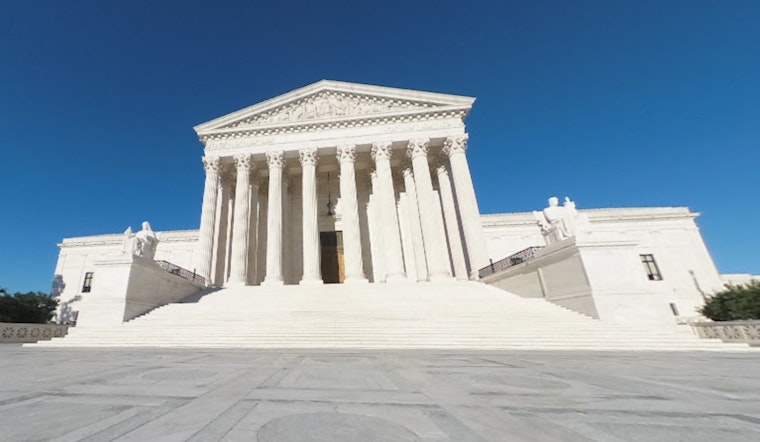
The Supreme Court has handed the Trump administration a procedural assist in its long-running fight over what federal immigration judges are allowed to say in public, keeping a contested Justice Department speech policy in place for now.
In a brief unsigned order, the justices reversed a lower court’s decision and sent the case back for more work, rather than ruling on the core First Amendment challenge. The move keeps the underlying dispute alive and leaves intact a Justice Department rule that requires immigration judges to get permission before making certain public remarks.
As reported by Reuters, the Court also turned down the judges’ separate request to press ahead in federal court on the threshold question of whether their challenge belongs there at all, or must go first through administrative agencies.
What the EOIR rule says
The speech policy at the center of the case, revised in 2021, tells immigration judges they must obtain prior approval before any “official” speech or writing that touches on immigration law, agency programs or their work duties.
The Fourth Circuit’s opinion, summarized on Justia, lists examples of what the agency treats as official activity: immigration conferences, stakeholder meetings and pro bono trainings, among others.
Critics say that approach blurs the line between judges’ personal views and their official role, and that it has discouraged some from taking part in public legal discussions at all.
How the case reached the high court
The National Association of Immigration Judges filed suit in July 2020, arguing that the policy works as an unconstitutional prior restraint on their speech. Court filings and docket entries are compiled by the Civil Rights Litigation Clearinghouse.
A federal judge in Virginia dismissed the case in 2023, holding that the Civil Service Reform Act funnels this kind of workplace dispute into an administrative process instead of straight to federal court. The Fourth Circuit later vacated that dismissal and sent the case back, instructing the district court to dig into whether those administrative channels still offer sufficiently independent review.
Supreme Court's procedural move
The Supreme Court’s new order faults the Fourth Circuit for leaning on arguments that were not squarely presented by the parties. The justices told the lower courts to resolve the case through the usual procedures, according to Reuters.
Because the ruling is narrow and unsigned, it does not say whether the Justice Department’s speech rule violates the First Amendment. That constitutional showdown will have to wait.
Why it matters
The Executive Office for Immigration Review, which runs the nation’s immigration courts, employs roughly 750 immigration judges. The speech policy affects what those judges can publicly say about case backlogs, due process concerns and day to day agency practice.
As the Fourth Circuit noted, the rule’s reach, combined with the practical difficulty of getting timely approvals, has led some judges to skip public presentations altogether or to revise their remarks so they stay comfortably within agency lines.
Legal implications
Legally, the fight centers on the Civil Service Reform Act’s exhaustion requirements and whether the administrative bodies involved, including the Merit Systems Protection Board and the Office of Special Counsel, still provide genuinely independent review.
The Knight First Amendment Institute, which represents the judges in court, has argued that the policy improperly forces a constitutional free speech claim into a labor relations process. As one of its attorneys put it, “Immigration judges shouldn’t have to go through a cumbersome labor relations process to vindicate their free speech rights,” according to the Knight First Amendment Institute.
What’s next
With the Supreme Court sending the case back, the district court is expected to pick up the factual inquiry the Fourth Circuit called for, including whether recent removals of agency officials have weakened the Civil Service Reform Act review structure.
The litigation is set to continue in district court while both sides press their procedural and constitutional attacks on the Executive Office for Immigration Review speech policy. Public filings and docket listings are collected by the Civil Rights Litigation Clearinghouse.





