

























































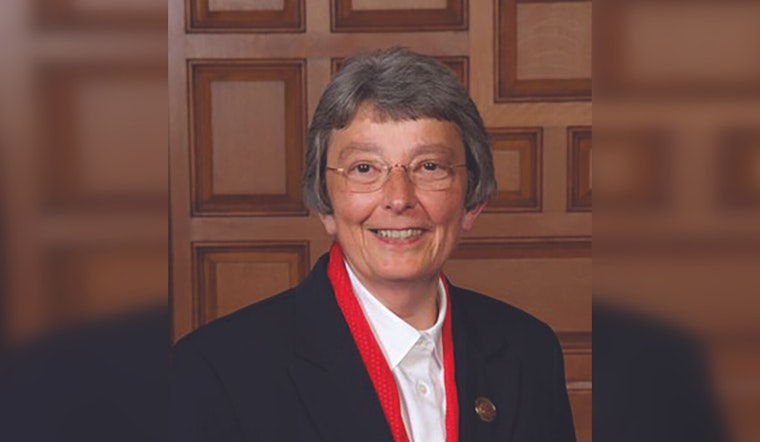
Barbara A. Lenk, the first openly gay justice to serve on the Massachusetts Supreme Judicial Court, died Tuesday at age 75, the court announced. Her legal career stretched from the Superior Court to the Appeals Court and ultimately nearly a decade on the state’s highest bench. Known for careful, principled opinions and a deep interest in civil litigation and First Amendment issues, Lenk briefly stepped in to perform the duties of chief justice after Ralph D. Gants’s death in 2020 before retiring later that year.
As reported by The Boston Globe, the court said Lenk’s opinions “were known for their rigorous reasoning, careful attention to detail, and dedication to fairness.” The statement did not specify a cause of death. Her passing comes a little more than three years after her December 2020 retirement, which capped more than 25 years on the bench.
Court career and milestones
According to her biography on Mass.gov, Lenk earned a Ph.D. in political philosophy from Yale before graduating from Harvard Law School in 1979. She went on to join Brown, Rudnick, Freed & Gesmer, where she became a partner, building a reputation in complex civil matters long before taking the bench.
Governor William Weld appointed her to the Superior Court in 1993, and she was elevated to the Appeals Court in 1995. In 2011, Governor Deval Patrick named her to the Supreme Judicial Court, a move that made history and put an openly gay justice on Massachusetts’ top court. The state biography highlights her extensive work on civil litigation and free speech questions and notes her mandatory retirement on Dec. 1, 2020.
Notable opinions
Lenk left her mark through a series of closely watched opinions. In 2012, she authored a unanimous ruling that reversed an involuntary manslaughter conviction in an unattended childbirth case, an opinion that, as reported by WBUR, emphasized the limits on imposing criminal liability for decisions surrounding childbirth.
In 2019, she wrote the court’s fair-report decision in a dispute involving a UMass police blotter and a student newspaper, a ruling detailed in Massachusetts Lawyers Weekly. That opinion clarified protections for journalists who rely on official records, and it fit squarely within Lenk’s text-driven, methodical approach to balancing institutional interests and individual rights.
Reaction and legacy
The court’s statement, quoted in The Boston Globe, praised Lenk’s “rigorous reasoning” and dedication to fairness, a reputation that fellow jurists say set a high bar for legal writing and analysis. Her 2011 appointment was widely seen as a milestone, and advocates and colleagues have often pointed to the symbolic weight of having an openly gay justice on the state’s highest court.
Legal observers note that Lenk’s body of work is likely to continue shaping Massachusetts law on free speech, privacy and family-law issues for years to come. The court did not immediately release details about services, and more formal tributes from legal organizations are expected in the coming days. For many who worked with her, Lenk’s legacy is defined by clear, carefully reasoned opinions that bridged practice, scholarship and long service on the bench.





