

























































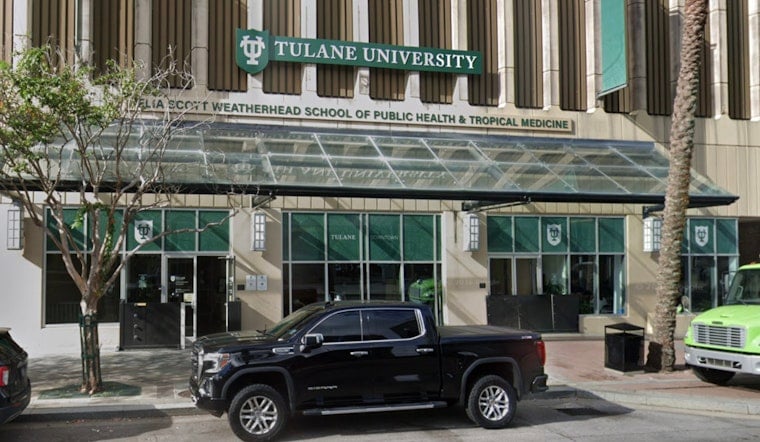
Tulane University has cashed out of its Canal Street high-rise while keeping a front-row seat downtown, selling the Tidewater Building at 1440 Canal St. in a long-term sale-leaseback that keeps the school as the anchor tenant. The deal shifts ownership of the tower but leaves Tulane’s Celia Scott Weatherhead School of Public Health and Tropical Medicine in place, with university leaders saying the move frees up close to $180 million for other real estate priorities.
As reported by NOLA.com, court filings describe a roughly $178 million financing package tied to the sale-leaseback of the 26-story tower at 1440 Canal. Tulane will stay on as tenant under an initial 15-year lease, with two additional 10-year renewal options. Patrick Norton, quoted in that reporting, said the transaction is "part of efforts to evaluate financing and real estate strategies to support Tulane's long-term mission." University officials are pitching the move as a way to unlock capital while holding on to operational control of the Canal Street property.
How the deal was financed
Public records show the Finance Authority of New Orleans held a hearing in February on a proposal to issue up to $200 million in lease-revenue bonds, with the proceeds to be loaned to Pan-American Financial Assistance Foundation Inc., a Delaware nonprofit set to be the building’s initial owner. According to the authority’s notice, those tax-exempt qualified 501(c)(3) bonds would cover the acquisition of the office tower at 1440 Canal, fund required reserves and pay issuance costs. The authority’s documentation lists the Foundation as the planned owner and lays out the bond structure behind the transfer.
The buyer and the building's history
Court documents and related reporting indicate the buyer is a nonprofit connected to New York-based investment firm Veyron, which bills itself as a private investment firm focused on mission-aligned financing and long-term asset holdings. As outlined by Veyron, the firm has been building a nationwide portfolio designed to support institutional partners. The 26-story high-rise, long known as the Tidewater Building, was designed in the late 1960s by Kessels-Diboll-Kessels and completed in 1971. Tidewater later donated the property to Tulane in 1993, according to reporting by NOLA.com.
What it could mean for downtown projects
Tulane has been steadily growing its downtown footprint, including signing a long-term lease for a major role in the Charity Hospital redevelopment. Per Tulane University, the school is slated to occupy more than a third of the roughly 1-million-square-foot project. That redevelopment has been described as central to the university’s push to make downtown a hub for biotech and innovation. The Canal Street sale-leaseback is the latest move in a broader real estate strategy that officials say is meant to reinforce Tulane’s long-term mission and solidify its presence across New Orleans.
Officials have not released a specific closing date or a project-by-project breakdown of how the sale proceeds will be spent, and the deal still has to clear standard bond closings and administrative approvals. Tulane and representatives linked to the buyer did not immediately offer further details. Even so, the transaction highlights how universities are leaning on sale-leasebacks to tap into capital while keeping programmatic control over prime campus-linked real estate.





