

























































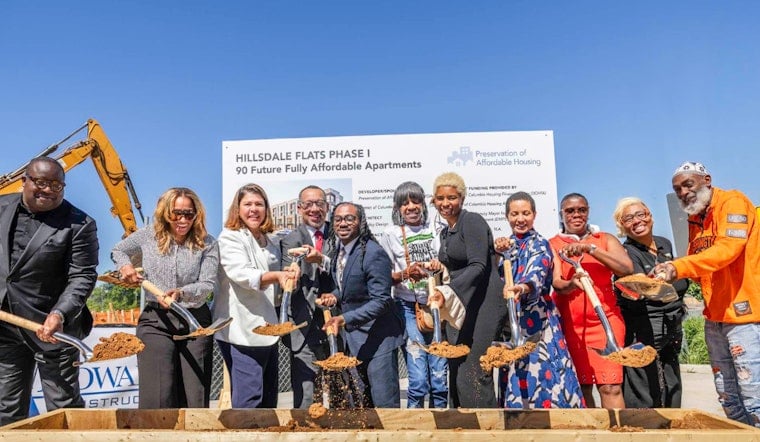
Shovels hit the ground Wednesday morning at the Barry Farm site in southeast D.C., as city officials and former residents kicked off construction of Hillsdale Flats, a 90-unit, fully affordable, townhome-style apartment development. The project is the latest phase in the long-running plan to rebuild Barry Farm after the public-housing buildings were demolished in 2019, and it folds into a broader effort that is expected to deliver roughly 380 replacement units for households displaced during earlier demolition.
Forty-two of the Hillsdale Flats apartments are set aside as a priority leasing pool for former Barry Farm residents, and developers say they are aiming to open the building in December 2027. City leaders have framed the project as one-for-one public housing replacement on site, plus additional affordable homes for Ward 8.
Residents Show Up To Reclaim Neighborhood Identity
NBC4 Washington covered the ceremonial groundbreaking, noting that Vernell Powell, a former Barry Farm resident and member of go-go group The Junkyard Band, plans to be among the first to move into Hillsdale Flats. Powell told the outlet, “We got what we got, so we’re going to make the best of it and bring the identity back,” adding that the neighborhood’s history will endure even as its buildings are rebuilt.
How The Project Is Paid For
The District of Columbia Housing Authority announced last December that it had closed financing for Hillsdale Flats, securing roughly $98.5 million to build and support the 90-unit Phase I, according to a District of Columbia Housing Authority news release. That release states that the full Barry Farm redevelopment is planned to include at least 900 affordable rental and for-sale homes, with about 380 of those serving as public-housing replacement units for former residents.
The same announcement details the mix at Hillsdale Flats: seven one-bedrooms, 31 two-bedrooms that include nine live-work units, 33 three-bedrooms, 15 four-bedrooms and four five-bedrooms. All apartments are slated to be income-restricted for households at or below 80 percent of area median income. DCHA and nonprofit developer Preservation of Affordable Housing are listed as co-developers, and the financing stack includes support from both city programs and private partners.
Long Roots, Long Redevelopment
Barry Farm dates back to an 1867 settlement organized by the Freedmen’s Bureau and later evolved into a public-housing community. Most of the 20th-century public-housing structures were demolished in 2019 under the District’s New Communities Initiative, according to project materials.
The Barry Farm redevelopment site describes a phased plan that has already produced The Asberry, a 108-unit senior building, and The Edmonson, which is now under construction. The full buildout is expected to add a new park, retail space and a cultural center that honors the neighborhood’s history. Project materials say the goal is to avoid displacement by providing one-for-one replacement housing on the Barry Farm site itself and to direct benefits such as hiring and future retail opportunities to the surrounding community.
Money, Timing And Where It Sits
Financial coverage in the Commercial Observer and public filings indicate that DCHA and Preservation of Affordable Housing closed on tax-exempt bonds and Low-Income Housing Tax Credit equity to fund Hillsdale Flats as part of a broader slate of Ward 8 projects. Public finance documents, including DCHFA listings in D.C. Council records, place the new building along Firth Sterling Avenue SE within the roughly 34-acre Barry Farm footprint that is bounded by Suitland Parkway and Wade Road. For more specifics on the structure of the deal, see the D.C. Council finance filings.
The phased financing strategy mirrors earlier Barry Farm work, where developers have emphasized larger, family-sized units and have highlighted efforts to steer contracting dollars toward Certified Business Enterprises.
Next Steps And Leasing
Project leaders say resident outreach and lease-up planning will ramp up as construction moves forward, so that former Barry Farm households and other eligible renters can be notified about priority leasing opportunities. City officials and Preservation of Affordable Housing plan to continue community meetings and workforce programming tied to the construction timeline, and developers say they will track compliance with replacement-housing promises as each new building opens.
For many in Anacostia, Wednesday’s groundbreaking was less about the ceremonial shovels and more about a long-promised return of neighbors to homes on land with deep family and civil-rights roots.





