

























































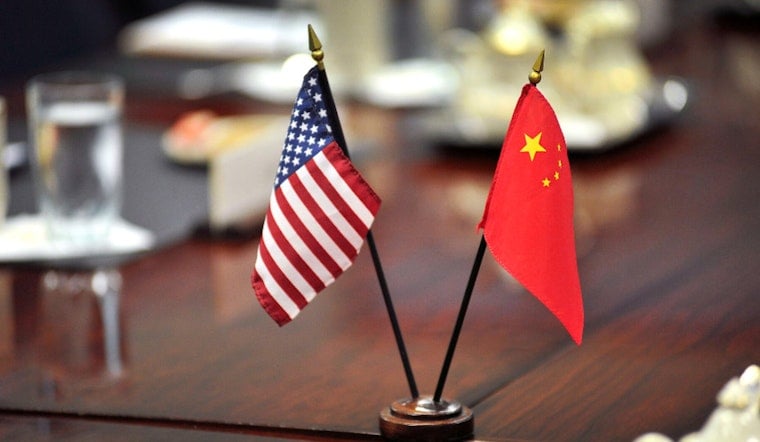
China's Ministry of Commerce banned six American organizations from doing business with Chinese entities and tightened export controls on drone technology on Wednesday, marking a sharp escalation in the trade standoff between Washington and Beijing. The ministry also opened what it called an unprecedented national security investigation into imported office printers and copiers, all in a single day of retaliatory measures aimed squarely at the machinery of U.S. trade enforcement.
Six U.S.-Linked Groups Cut Off From Chinese Business
The six blacklisted entities are Applied DNA Sciences, Inc., Stratum Reservoir, LLC, Altana Technologies, Inc., the Responsible Business Alliance, Verité Group, Inc., and Human Rights in China, according to Global Times. Chinese officials said the ban responds to the groups' support for U.S. forced-labor sanctions tied to Xinjiang.
Altana Technologies had been selected by U.S. Customs and Border Protection in 2025 to deploy its "product passport" software, which maps multi-tier supplier networks to verify compliance with U.S. forced-labor law, according to Geopolitechs. By cutting off Chinese trade-data access for that platform, Beijing's order strikes directly at a tool American importers use to trace supply chains back to Xinjiang.
In a separate order issued the same day, China's Ministry of Commerce blacklisted Compliance Testing LLC, a Mesa, Arizona-based lab, accusing it of helping the U.S. Federal Communications Commission take actions that harm Chinese sovereignty, as reported by Xinhua. The firm provides testing services that allow electronic products to secure FCC certification for sale in the U.S. market.
First-Ever Security Probe Targets Office Printers
Beijing also launched what it described as its first-ever foreign trade national security investigation, targeting imported office printers and copiers that run on foreign-developed driver or embedded software, invoking Article 41 of China's Foreign Trade Law, according to Global Times. The 12-month probe will examine whether reliance on foreign office-imaging software poses risks to national security.
China's new export controls on dual-use drone technology stop short of an outright ban, but they eliminate license facilitation measures for U.S.-bound shipments, according to DroneLife. Motors, batteries and sensors bound for American drone manufacturers will now require individual case-by-case review, a shift the outlet reports could delay supplies for companies that still lean heavily on Chinese component suppliers.
Drone Parts Squeeze Builds on Earlier Sanctions
Wednesday's move builds on a prior escalation from June 22, when Beijing barred exports of dual-use components to 10 U.S. defense contractors and drone developers, including Red Cat Holdings, Teal Drones, AVEOX and IMSAR, as Hoodline reported in its piece on Beijing's export squeeze. That June action targeted firms already facing Pentagon blacklists, and this week's order widens similar restrictions across the broader commercial drone supply chain.
Beijing's countermeasures followed closely on the heels of U.S. action. The Department of Homeland Security announced last Friday that it had added 43 Chinese companies to the Uyghur Forced Labor Prevention Act Entity List, expanding the blacklist to 187 total entities in the largest single update since the law took effect, according to the U.S. Department of Homeland Security. Since the law took effect in 2021, U.S. Customs and Border Protection has denied entry to more than 24,300 commercial shipments valued at nearly $1 billion through July, the department's announcement noted.
Trade Truce Frays Ahead of Xi's Planned September Visit
The retaliatory package landed less than a week after Chinese Vice Premier He Lifeng and U.S. Treasury Secretary Scott Bessent held a high-level video conference last Thursday focused on maintaining bilateral trade stability, according to the Los Angeles Times. Chinese officials reportedly expressed frustration that the U.S. forced-labor list expansion came just a day after those consultations.
The dispute also traces to the Federal Communications Commission's expanded "Covered List," which bars imports of foreign-made military-grade drones, advanced humanoid and quadruped robots, and solar power inverters, per the Express Tribune. China's Ministry of Commerce described the U.S. rules as "erroneous practices" and said it had no choice but to take necessary countermeasures, calling on Washington to reverse course, as reported by KABB.
In its statement, the ministry added that the U.S. measures "seriously violate the consensus reached by the two heads of state and damage China's legitimate rights and interests," per the same report. Separately, China's State Administration for Market Regulation has barred U.S. companies that conduct follow-up factory inspections for Chinese entities from issuing CCC certifications, which verify that products meet Chinese safety standards. President Donald Trump traveled to Beijing on May 14 to discuss trade, regional security and bilateral ties with President Xi Jinping, and Xi is now planning to travel to the United States in September, according to the same account.



