

























































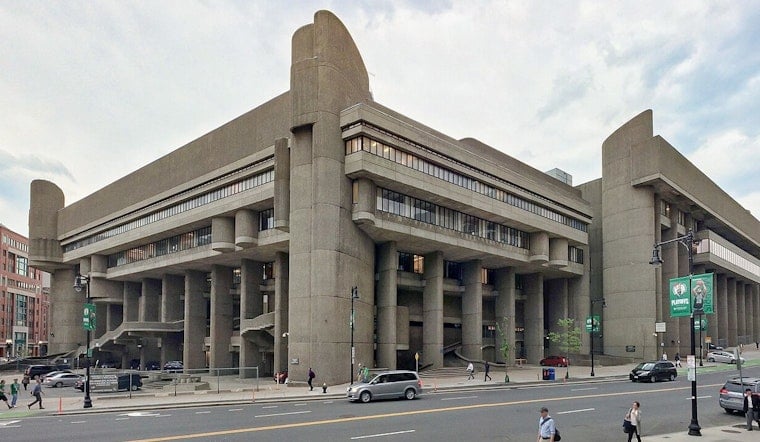
The hulking Boston Government Services Center, a pair of connected Brutalist slabs that swallow an entire West End block, may finally be headed for a second act built around housing, retail, and public space. After decades of deferred maintenance and fenced off plazas, state officials are gearing up to seek redevelopment proposals that would reconnect the complex to the surrounding streets. For neighbors who have hurried past the concrete walls for years, the question is both simple and huge: can a fortress be opened up and turned into something that feels like part of a neighborhood?
As reported by The Boston Globe, staff from the Division of Capital Asset Management and Maintenance, or DCAMM, recently led a tour of the Lindemann and Hurley buildings and said the state is expected to issue a formal call for redevelopment proposals. The Globe notes that the Hurley building holds roughly 300,000 square feet of mostly unused office space, while the Lindemann building, designed by architect Paul Rudolph, still houses a Department of Mental Health residential program. DCAMM commissioner Adam Baacke told the paper that the complex was built as a kind of “fortress,” a description the Globe used to underscore exactly what planners now hope to undo.
According to Mass.gov, DCAMM describes the Lindemann Hurley site as roughly 5.5 acres and says it will oversee a competitive disposition process to select a private development partner. State materials include draft design guidelines and a Final Project Proposal and spell out that any redevelopment plan must provide upgraded space for the Department of Mental Health and preserve key historic elements of the complex. DCAMM also states that proposals will be evaluated on design quality, sensitivity to preservation, and the quality and cost of the space that remains in use for the Commonwealth.
Lindemann's Surprises and Preservation Stakes
Inside the complex, there are details that complicate its reputation as a pure eyesore. There are skylit chapels, curving staircases, and a carved Costantino Nivola mural from 1969 that stretches across the Hurley lobby. The Boston Preservation Alliance has urged DCAMM to focus on adaptive reuse and has taken part in the consultation process, arguing that the most important historic fabric of the complex should be retained even as new housing and retail are introduced. National preservation advocates at Docomomo have also praised the state’s outreach and pressed for solutions that balance preservation with bringing new life and activity to the site.
Money, Rules and the Conversion Pitch
A big part of the current pitch is financial. Boston’s Office to Residential program, which offers a 75 percent property tax abatement for 29 years and expedited permitting, has made the numbers on large downtown conversion projects more appealing, according to city officials. The city’s program page and recent announcements lay out the incentives and milestones that have helped spur conversion proposals, while lenders and contractors warn that strict preservation requirements and irregular floor plates can still drive up costs. The site has drawn interest before, and the state selected Leggat McCall in 2022 for a Hurley redevelopment proposal, but earlier schemes that leaned heavily on lab and office space ultimately stalled in the face of changing market demand and design concerns.
Neighbors Want Parks, Porosity and Protections
People who live and work nearby want more than another batch of condos. Neighbors and civic groups are calling for the long closed plaza to be reopened as a park, for safe pedestrian routes that cut through the block, and for firm guarantees that state mental health programs will not be pushed out. DCAMM’s project page records public hearings and a formal comment period and states that any redevelopment must include upgraded Department of Mental Health facilities and improvements to public access. Preservation advocates argue that a careful adaptive reuse could finally stitch this “superblock” back into the street network of the West End and Government Center.
Next up is the unglamorous but crucial part: assembling an offering package, issuing a Request for Proposals, and then likely enduring months of design review and community meetings before any construction can begin. As The Boston Globe noted, if a developer can align preservation, public benefits, and financing, the project could finally transform a deadening downtown fortress into a lively stretch of the city. If that does not happen, the complex faces the very real possibility of another decade of neglect.


