

























































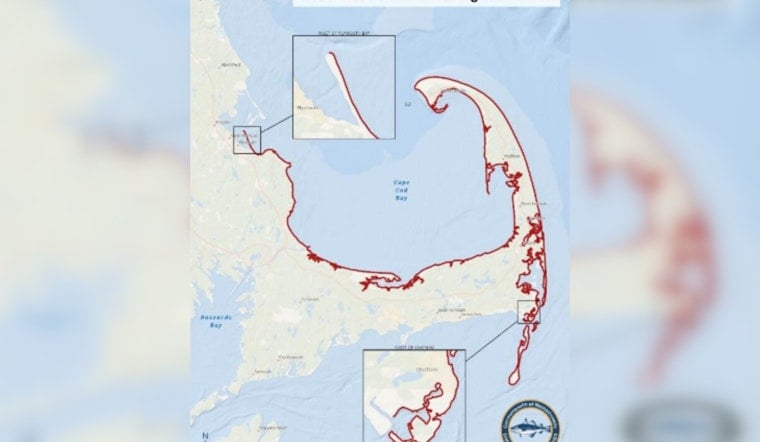
Massachusetts officials are putting shore anglers on notice: “heavy” shark-fishing tackle is off limits along a big swath of the Cape this summer, part of a push to cut risks for swimmers and ease the strain on large sharks. The ban targets rod-and-reel setups that combine metal or wire leaders longer than 18 inches with hooks wider than 5/8 inch, and it applies along the shoreline from the northernmost point of Plymouth Beach around Cape Cod Bay and the Outer Cape. Regulators have also outlawed mechanized and remote devices for deploying bait and set daytime limits on chumming in places where heavy gear is still legal.
The new rules were rolled out by the Massachusetts Division of Marine Fisheries, which says the restricted zone is designed to discourage anglers from intentionally targeting white sharks and to make existing protections easier to enforce, according to Massachusetts Division of Marine Fisheries. Heavy gear is still allowed outside the marked shoreline, and anglers can keep fishing in the zone with lighter tackle for other species.
State guidance also outlaws drones, bait cannons and radio-controlled boats for sending baits beyond the breakers, and it bans chumming from sunrise to sunset in areas where heavy gear is permitted, as highlighted by On The Water. Regulators say the goal is to keep beachgoers safer and cut down on long, exhausting fights that can increase post-release stress and mortality for sharks and other non-target species.
Where the ban applies
The no-heavy-gear zone starts at the northernmost point of Plymouth Beach and traces the shoreline around Cape Cod Bay, covering the Outer Cape and spots such as Monomoy Island, Chatham Harbor and Stage Harbor, according to the state map. Local reporting notes that anglers who blow off the rules can expect enforcement from state officers and urges fishermen to study the maps before they hit the sand, as outlined by New Bedford Guide.
If you hook a shark
Officials are spelling out catch-and-release basics meant to give sharks the best shot at survival: keep the animal in the water with its gills submerged, keep handling and overall fight and release time as short as possible, do not sit on the shark’s back, and skip the extended photo shoot. DMF advises using long-handled dehooking tools when they will not drag out the release and carrying wire or bolt cutters to quickly remove a leader or hook if needed, according to guidance from the Massachusetts Division of Marine Fisheries.
Why now
The advisory arrives as white sharks and other big species are already showing up off the coast this spring. The first confirmed great white of the season was reported in mid May, according to NBC Boston. Researchers and conservation organizations, including the Atlantic White Shark Conservancy, note that shark activity tends to build through the summer and peak in the fall, and they encourage the public to use trackers and apps to stay in the loop, as reported by WCVB.
What anglers should do
Before you head to the beach, check your setup and be ready to downsize to lighter leaders and smaller hooks inside the restricted zone, keep tools handy so you can cut leaders fast if needed, and skip chumming during the off-limits hours. For maps of the closure and a plain-English rundown of the rules, see the advisory summarized by New Bedford Guide and consult the Division of Marine Fisheries for the full legal language.





