

























































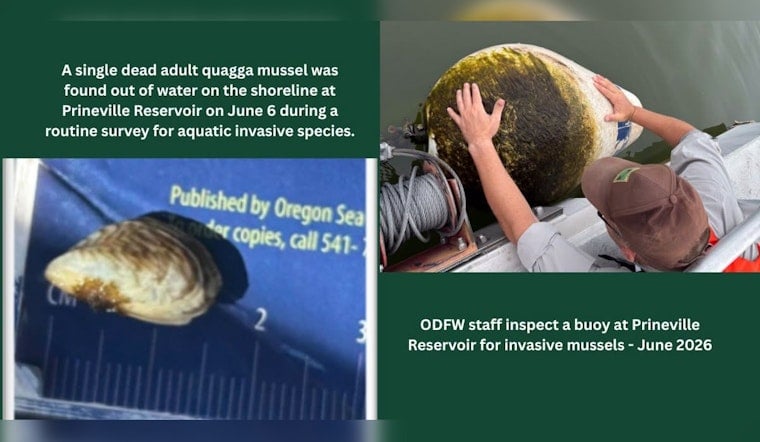
One tiny shell on a Prineville Reservoir shoreline was all it took to send Oregon wildlife officials into high alert.
On June 6, a dead quagga mussel shell turned up on the banks of the central Oregon lake, triggering a rapid, multi-agency response and intensive surveys in and around the reservoir. The discovery has state and federal partners on edge, given how this small invader has wreaked havoc on waterways and water systems elsewhere in the West.
What Officials Found
According to KATU, the Oregon Department of Fish and Wildlife reported that a single dead adult quagga mussel was discovered out of the water along the Prineville Reservoir shoreline on June 6. Portland State University researchers followed up with intensive surveys and water tests, which turned up no additional mussels, the agency told the station.
"Our top priority is protecting Oregon's waters," ODFW Aquatic Invasive Species Coordinator Keith DeHart said.
Why Quagga Mussels Matter
Quagga mussels are tiny filter feeders that reproduce quickly, strip plankton from the water column and can reshape entire aquatic food webs. They are also notorious for clogging intake pipes, irrigation systems and boat motors.
The USGS Nonindigenous Aquatic Species database notes that infestations in other regions have led to expensive decontamination efforts and long-term maintenance headaches. That combination of ecological damage and infrastructure costs is why any detection, even a single shell, is treated as a serious warning sign.
State Response And Inspections
ODFW says it is working with state, federal, tribal and local partners and is prepared to move quickly as new scientific evidence comes in. The agency points to its Waterway Access and Aquatic Invasive Species program as a key funding source for inspection stations, public education and rapid-response work in high-risk waters, according to ODFW.
Regional partners previously ran a multi-agency exercise at Prineville Reservoir in 2013 that tested the state's rapid-response playbook, according to ODFW's past coverage. The latest discovery comes on the heels of earlier mussel interceptions on trailered boats, a reminder that inspections and decontamination remain the front line of defense.
What Boaters And Anglers Should Do
Officials are asking anyone who hits the water to stick to the basics: clean, drain and dry boats and gear after leaving any waterbody, and stop at posted inspection stations when entering Oregon.
Permits collected through the state's Waterway Access program help pay for those inspection and decontamination efforts. If you think you have spotted quagga mussels or other suspect hitchhikers, do not move the boat or equipment. Instead, report what you see to ODFW at [email protected] or (503) 947-6000.
What's Next
State and university teams plan to continue targeted surveys and lab testing around Prineville Reservoir and will update the public as results come in.
"This is a serious environmental and economic concern for Oregon and the Pacific Northwest," officials told KATU.





