

























































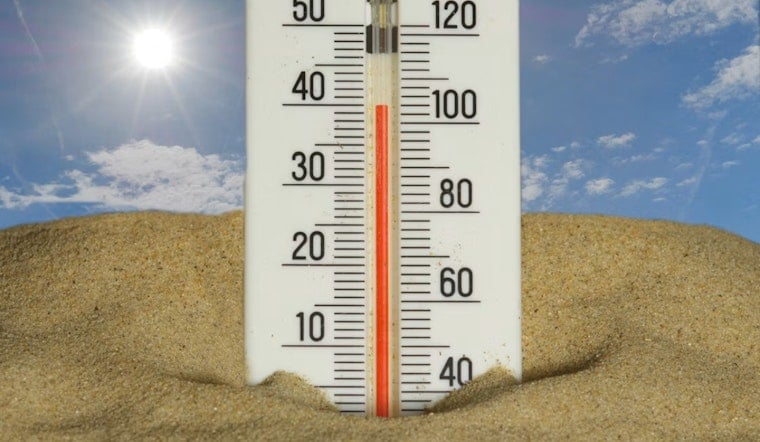
A new online tool is putting San Diego’s hottest neighborhoods on full display, long before the next heat wave hits. The San Diego Heat Risk Explorer, a countywide interactive map that went live this month, lets residents see which areas face the greatest danger from extreme heat both now and under future warming scenarios.
The map blends temperature data with social and infrastructure factors such as income, age, tree canopy and access to air conditioning. It then generates tract-level risk scores that city planners, health agencies and community groups can put to work. In a region where mild coastal breezes can hide punishing inland heat, the Explorer is designed to make those contrasts visible and harder to ignore.
Users can move among three core “pillars” of risk, switch on and off single variables like daytime or nighttime heat, and test climate scenarios for 2050 and 2080 to see how risk shifts over time. The tool also overlays county cooling sites, tribal lands and land-surface temperature, and it lets users export PDFs or download the underlying CSV and GeoJSON files for deeper local analysis. You can try it yourself at the San Diego Heat Risk Explorer.
How the Explorer Calculates Risk
The Explorer builds a composite score from three pieces: how hot a place gets, who lives there and how well that community can cope with heat. In other words, a scorching thermometer reading is only part of the story. That approach mirrors the City of San Diego’s Urban Heat Vulnerability Index, which folds land-surface temperature together with demographic and health data, according to the City of San Diego.
By flagging which factor is driving the score in each census tract, the map can point officials toward targeted fixes, whether that is tree planting, reflective or sealant treatments for pavement, or adding cooling centers where none currently exist.
What the Maps Reveal About Vulnerability
One of the clearest messages from the Explorer is that the same temperature can play out very differently from block to block. Some coastal neighborhoods show high sensitivity because many homes lack air conditioning, while certain inland tracts score better than you might expect because residents have more access to cooling centers.
Researchers say the tool’s blend of public-health, census and weather data helps explain those kinds of tradeoffs and makes them visible to people who do not normally sift through raw datasets. “It’s like democratizing data,” one of the project’s researchers told KPBS. That kind of clarity can help community organizations focus outreach on seniors, outdoor workers and families with young children who are more likely to suffer in extreme heat.
Where Local Leaders Plan to Act
The Explorer was developed by the San Diego Regional Climate Collaborative at the University of San Diego and the Center for Climate Change Impacts and Adaptation at Scripps, with state grant funding to support local heat-action planning. The City’s Extreme Heat Action Plan links directly to that effort and names the Explorer as a tool for prioritizing cooling projects, according to the City of San Diego.
The collaborative also publishes guidance and reports that help cities and nonprofits turn the Explorer’s data into on-the-ground work, from community engagement to technical assistance, per the San Diego Regional Climate Collaborative.
How To Use The Tool
To get started, type in an address, select “Build Composite Risk Map,” and then compare two census tracts side by side to see which variables push each community’s score up or down. The export tools let neighborhood groups, journalists and planners pull the data as CSV or GeoJSON, or save a PDF that can be brought into public meetings and planning sessions. Hands-on exploration and downloads are available at the San Diego Heat Risk Explorer.
Whether you are a city planner mapping out where to plant trees next or a neighbor checking on older relatives during a hot spell, the Heat Risk Explorer offers a sharper view of where cooling investments and outreach could save lives. With hotter summers expected in the coming years, local officials say this kind of targeted, neighborhood-level planning will be critical to protecting the county’s most vulnerable residents.





