

























































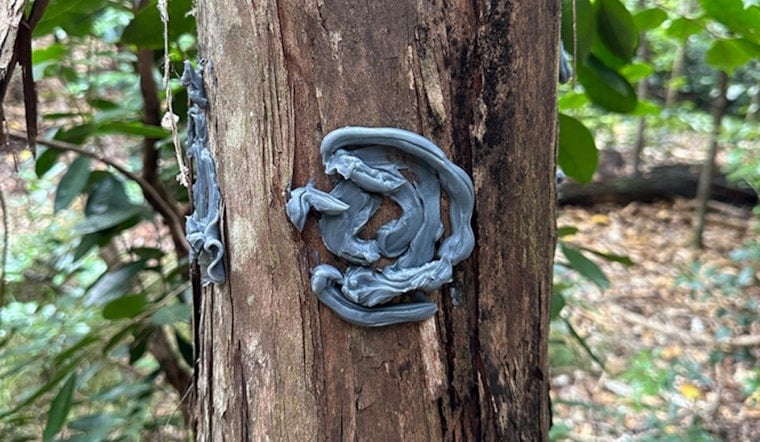
Foresters on Kauaʻi are rolling out a new line of defense in the fight against Rapid ʻŌhiʻa Death, dotting trunks in the Kōkeʻe State Park area with a pheromone-based beetle repellent known as SPLAT® Verb. Crews are placing sticky blobs of the product on trees already killed by the disease and on nearby healthy ʻōhiʻa in an effort to keep ambrosia beetles from boring into stressed trees and kicking infectious frass back into the forest.
According to the Department of Land and Natural Resources, the Division of Forestry and Wildlife has teamed up with the U.S. Forest Service to deploy SPLAT® Verb on Kauaʻi. DOFAW State Protection Forester Robert Hauff called the treatment “a significant step forward in mitigating the spread of ROD” and noted that the State Department of Agriculture’s Pesticide Branch has registered the product for use in Hawaiʻi. Recent work has zeroed in on the Kōkeʻe State Park area, where managers have been tracking new ʻōhiʻa losses.
How the repellent works
SPLAT® Verb carries verbenone, a semiochemical that sends a “keep out” signal to ambrosia beetles and discourages them from colonizing treated trees. Field trials at Waiākea Forest Reserve in 2022–23 that tested verbenone in the commercial SPLAT formulation showed lower beetle counts on treated trees, according to the U.S. Geological Survey. That experimental work, led in part by U.S. Forest Service forest entomologist Kylle Roy, helped set the stage for the practical deployment now underway on Kauaʻi.
Where the repellant fits in the statewide strategy
The Rapid ʻŌhiʻa Death Strategic Response Plan for 2026–2030 lists repellents as one of the tools to reduce beetle-related spread and notes that SPLAT® Verb is now registered for use in Hawaiʻi. The plan documents that more than a million ʻōhiʻa have died on Hawaiʻi Island and roughly 1,000 on Kauaʻi, a scale that underscores why land managers are experimenting with every viable tactic. It recommends pairing repellents with other measures such as surveys, fencing and hoofed-animal control, while scientists continue to test how large an area each treatment can protect and how best to deliver it.
What land managers and residents should do
DOFAW and partner agencies stress that repellents are a preventive measure, not a cure, and they are urging the public to stick with basic ROD precautions. That means not moving ʻōhiʻa plants or wood between islands, scrubbing and disinfecting boots and tools, and washing vehicles after visiting forested areas. The DLNR release also notes that SPLAT® Verb biodegrades in the field after about four months. On Kauaʻi, residents can report suspect trees and get local guidance from the Kauaʻi Invasive Species Committee.
Limits and next steps
Experts caution that repellents “do not completely protect trees,” and the ROD plan emphasizes that more research is needed to figure out exactly how far each treatment’s protective effect extends. The plan also calls for developing more efficient deployment methods, including potential drone applications, and notes that registration is in progress for additional products such as SPLAT Beetle Guard. Land managers say they will be watching treated plots closely to see whether beetle pressure and frass production actually drop as expected.
The Kōkeʻe deployment marks the latest chapter in a decade-long, multi-agency push to protect Hawaiʻi’s keystone ʻōhiʻa. Local reporting on the new treatment effort was published by Maui Now.





