

























































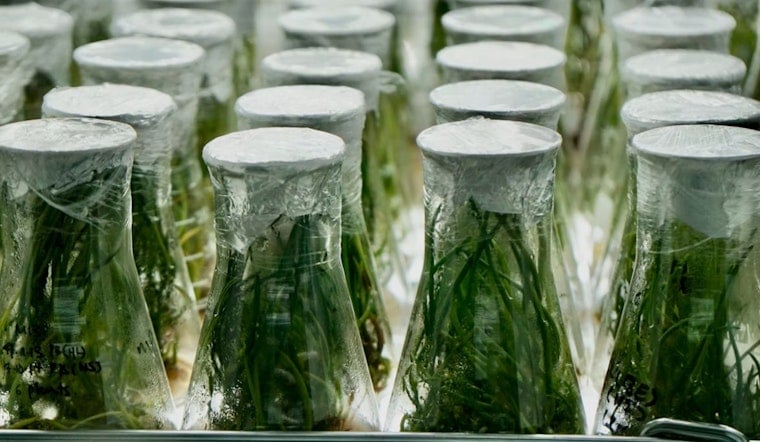
In La Jolla, engineers at UC San Diego say they have cracked a simpler way to grow and harvest medicine-grade particles from plants under space-like conditions, a potential step toward on-demand pharmaceuticals for long missions. The team showed off the approach using the plant-derived candidate cowpea mosaic virus (CPMV) grown in non-edible leaves, then developed a non-destructive “milking” method that keeps the tissue alive for repeat harvests. If the technique behaves the same way in orbit, future crews could top up fragile drug supplies with little more than light, water and soil.
The full study, published June 5 in npj Science of Plants, describes a workflow that pairs vacuum infiltration with gentle centrifugation to pull intact CPMV particles out of the leaf apoplast without grinding up the tissue. The resulting eluate is then cleaned using ultrafiltration and diafiltration to strip out smaller plant impurities, creating a leaner purification pipeline. The authors present the setup as a scalable, low-resource strategy for producing biologics aboard spacecraft and in remote corners of Earth.
According to UC San Diego, the team tested the pipeline on Nicotiana benthamiana and black-eyed pea plants and showed they could pull therapeutic particles from the apoplast while leaving leaves intact. “With plants, you can grow complex therapeutic compounds using light, water and soil,” senior author Nicole Steinmetz said in the university’s release. First author Patrick Opdensteinen noted that the usual blender-based extraction approach produces “something that looks like a smoothie,” and the new method neatly skips that step.
The paper reports that researchers harvested and purified CPMV from more than 50 plants in under two hours, and because the leaves remain intact the same plants can be tapped again, a big win for missions where both mass and waste are tightly constrained. The authors also ran plants through simulated space stressors and found that microgravity altered plant morphology, while temperature swings and oxidative stress in some cases slightly boosted CPMV yields, an effect the team ties to virus-host interactions. The work was supported in part by the National Institutes of Health (grant R01CA274640) and by the Translational Research Institute for Space Health through NASA (cooperative agreement NNX16AO69A), npj Science of Plants notes.
How the team simulated space
On Earth, the researchers mimicked microgravity with a custom random-positioning machine that constantly reorients plants to cancel out the pull of gravity. The hardware was adapted from materials science labs and calibrated by Maziar Ghazinejad’s group, according to the Steinmetz Lab. The team then layered on short- and long-term oxidative stress and heat cycles to approximate radiation effects before running the same apoplast extraction to check whether CPMV could still be recovered. The lab frames the work as part of a broader "From Plants to Planets" push to test plant molecular farming for one-health applications.
What comes next
Next steps include tracking how space-like conditions change plant water and nutrient uptake, and teaming up with UCSD’s Rocket Propulsion Laboratory to test how rocket launches affect seeds and genetic material, according to UC San Diego. Both the paper and the university release emphasize that CPMV does not infect mammalian cells, which lowers biosafety concerns for in-space production, although containment and testing would still be required. If those hurdles are cleared, the group argues, the platform could give long-duration missions a compact, renewable pharmacy and open the door to low-cost biologic production for under-resourced communities back on Earth.



