

























































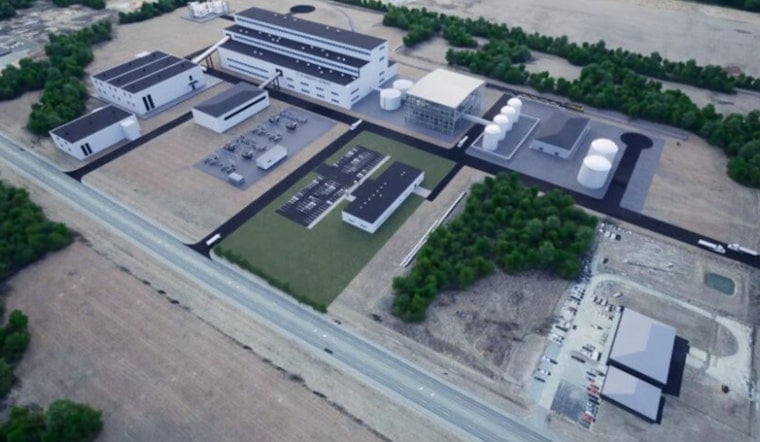
The long-planned Stardust Power lithium refinery on Muskogee’s south side has officially moved from paper plans to dirt work, with the company launching site engineering at its future plant inside Southside Industrial Park.
The first order of business is not shiny equipment but geotechnical borings and subsurface investigations. Those early, unglamorous steps will feed foundation, civil and procurement engineering for a facility that, if built as designed, would churn out up to 50,000 metric tons per year of battery-grade lithium carbonate. At that scale, the refinery would sit among the largest lithium-processing plants in the United States.
What the Site Engineering Covers
Stardust Power has hired Brown & Root to run the geotechnical program and carry out a series of borings and subsurface investigations, according to the Journal Record. The work is meant to translate the project’s completed Front-End Loading Level 3 (FEL-3) engineering into site-specific design data that can support foundation and structural planning.
The 50,000-metric-ton capacity figure the developer has been touting is documented in the company’s public SEC filings.
“With FEL-3 complete, we are now advancing the engineering activities that move the project from design toward execution,” Ken Pitts, Stardust Power’s director of construction and contracts, said in a company release quoted by the Journal Record. Founder and CEO Roshan Pujari has said the site engineering is intended to convert completed design work into site-specific data and to reduce construction risk, a clear signal that the company is trying to lock in schedule and cost certainty before any heavy construction begins.
Site and Logistics
The refinery site sits inside Southside Industrial Park near Port Muskogee, a location the developer has highlighted for its inland-waterway, rail and highway access. The port itself has publicly cheered the project’s regional logistics advantages. Port Muskogee noted the site’s multimodal links when Stardust Power broke ground in January 2025.
To power the operation once it is running, Stardust Power has also executed an infrastructure agreement with OG&E to develop an on-site substation to support the plant’s operational power needs, according to Stardust Power.
Permitting and Financing
On the regulatory front, the project cleared a major hurdle when the Oklahoma Department of Environmental Quality finished its review and issued an air-quality construction permit. The Oklahoma Department of Environmental Quality file spells out emissions controls and a zero-liquid-discharge wastewater approach for the refinery. The permit documents also lay down site coordinates and note the planned facility entrance off West 53rd Street near US-64.
On financing, Stardust Power has disclosed an institutional letter of intent that could support up to $150 million at the project level, and it reported roughly $1.2 million in cash as of March 31, 2026 in its quarter-end update, according to Stardust Power. The company’s prospectus and related SEC filings also describe non-binding feedstock and offtake arrangements the developer says underpin the refinery, including a 2025 non-binding letter of intent with Sumitomo for up to 20,000 metric tons per year.
Earlier company filings pegged Phase 1 of the project at about 25,000 metric tons per year, with an illustrative Phase-1 capital cost in the neighborhood of $500 million and a two-year construction window. Stardust Power has used those assumptions to frame its procurement and financing plans. The current round of site engineering is explicitly described as a risk-reduction step to generate the data contractors need to submit firm foundation bids and move equipment procurement forward.
For now, major earthwork and foundation work are still on hold, contingent on closing project-level financing and completing key procurement packages.
What This Means for Muskogee
State and local officials have been pitching the refinery as a major economic play. Stardust Power’s initial announcement said the build could qualify for roughly $257 million in performance-based incentives tied to jobs and local investment, according to Stardust Power.
Earlier coverage, including Hoodline’s January 2025 groundbreaking report, has framed the project as a multi-hundred-job development for the region.
For Muskogee, the launch of site engineering is a tangible milestone. It narrows some of the technical uncertainty around the project, but the real construction push will only materialize if Stardust Power secures the remaining financing and locks down its procurement plans.





