

























































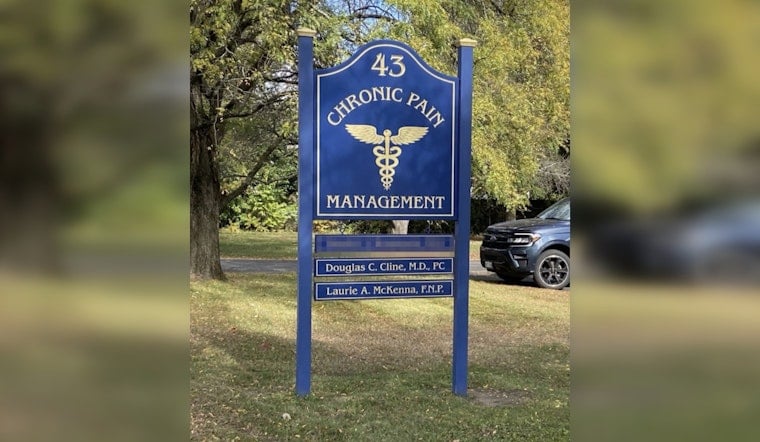
A Warren County doctor and a nurse practitioner who ran a Queensbury pain clinic that federal authorities say churned out high-dose opioid prescriptions for cash have been hit with a 20-year ban on holding federal DEA controlled-substance registrations and a $500,000 civil payout. Prosecutors say the cash-pay practice kept patients on powerful opioids and other controlled medications, sometimes without regular in-person exams, and tied continued access to prescriptions to recurring payments. The deal resolves federal civil claims and was rolled out this week as part of a nationwide health care enforcement sweep.
Warren County Physician & Nurse Practitioner Barred from DEA Registration for 20 Years for Prescribing Opioids Unlawfully; Agree to Pay $500k. @DEAHQ @TheJusticeDept @NDNYnews
— DEA New York (@DEANewYork) June 24, 2026
Federal settlement details
The U.S. Attorney’s Office in Albany said Dr. Douglas C. Cline and nurse practitioner Laurie McKenna agreed to pay $500,000 to settle civil allegations that they prescribed high-dose opioids and other controlled drugs without adequate medical oversight and linked continuing prescriptions to recurring cash payments. One of the civil actions zeroed in on prescribing practices involving a combat-wounded military veteran and his spouse, and prosecutors later brought a separate fraudulent-conveyance complaint after learning Dr. Cline had transferred substantial assets.
Under the settlement, both Cline and McKenna are barred for 20 years from applying for, renewing, or reinstating DEA controlled-substance registrations. The U.S. Attorney’s Office noted that Cline surrendered his DEA certificate on August 29, 2025, while McKenna’s registration expired on January 31, 2026, according to the U.S. Attorney's Office, Northern District of New York.
What prosecutors said
First Assistant U.S. Attorney John A. Sarcone III described Cline’s operation as “a high-volume, cash-pay medical practice in which hundreds of patients received high-dose opioid prescriptions, often in combination with other controlled substances,” according to the U.S. Attorney's Office, Northern District of New York. Sarcone also said that after federal scrutiny began, Cline transferred a lake house valued at more than $1 million to his then-spouse, reducing the pool of assets available to satisfy any potential judgment.
Officials with the Department of Health and Human Services Office of Inspector General said the alleged illegal prescribing practices put patients at risk and that the agency will continue working with law-enforcement partners to pursue similar cases, according to the HHS Office of Inspector General.
How the case reached court
Court records show the United States filed a civil action in late March 2024 against Douglas C. Cline M.D., P.C., which did business as Chronic Pain Management, and against McKenna. The case appears on the federal docket as United States v. Cline et al.
The complaint outlined prescriptions that allegedly involved escalating doses of fentanyl, oxycodone, and benzodiazepines despite red flags suggesting misuse, and it alleged that some patients continued to receive prescriptions even when they were not being examined regularly in person. The docket also lists the government’s civil claims under federal controlled-substances statutes, according to Justia Dockets & Filings.
Part of a national takedown
The Queensbury case did not land in a vacuum. Federal officials announced the settlement as one piece of the Department of Justice’s 2026 National Health Care Fraud Takedown, a coordinated two-week sweep that wrapped in hundreds of prosecutions and civil actions across the country.
According to the HHS Office of Inspector General, the operation targeted more than 450 defendants and more than $6.5 billion in alleged false claims, underscoring the government’s ongoing focus on abusive prescribing and billing in both public and private health programs.
What’s next
Prosecutors said the Cline and McKenna matter was developed with federal and state partners and litigated by Assistant U.S. Attorneys Christopher R. Moran and Adam J. Katz. The settlement closes out the government’s civil claims and locks in long-term administrative restrictions, but the announcement did not pair those penalties with any criminal charges in this case.
Anyone seeking information about medical records or past prescriptions tied to Chronic Pain Management has been directed to contact the U.S. Attorney’s Office in Albany for guidance. The federal court docket details the filings and the attorneys involved in the case, according to Justia Dockets & Filings.





