

























































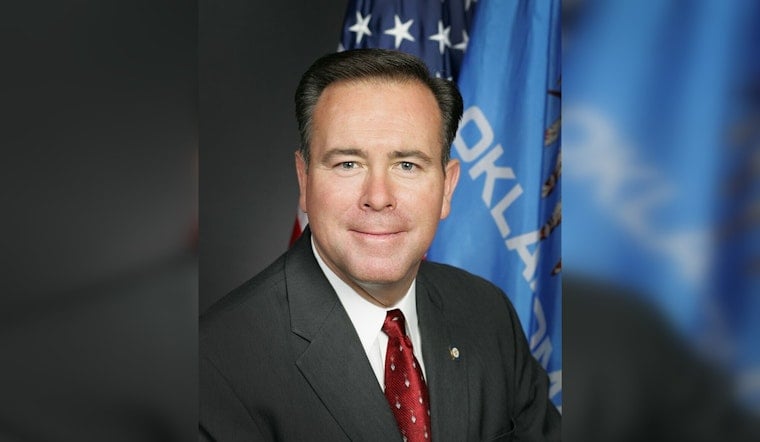
Newly released state vehicle and vendor records indicate that Oklahoma State Treasurer Todd Russ has been using a small unclaimed-property office in Clinton as a weekday launch point for regular trips between that satellite site and the Capitol in Oklahoma City. The pattern, which includes hundreds of trips and tens of thousands of miles logged over the past year, is drawing attention from watchdogs and prompting questions about whether the use of the state vehicle aligns with rules that restrict commuting in state-owned cars.
GPS data tied to a 2024 Ford Expedition assigned to the treasurer’s office shows more than 960 trips and over 26,000 miles in the past year. More than 100 of those trips registered top speeds above 90 miles per hour, and state fuel-card records reflect roughly $3,700 in fuel purchases. State law requires authorization from the Office of Management and Enterprise Services to use a state vehicle for commuting, yet the treasurer’s office did not produce an OMES commuting authorization in response to open-records requests. Those details come from reporters’ review of GPS logs, vendor files and lease records, according to KGOU.
Asked about the driving pattern, the treasurer’s office said in a May 29 written statement that “the vehicle is used by the treasurer and staff to access each of those sites as part of the constitutional duties of the office.” Russ opened the Clinton unclaimed-property satellite in June 2025 and later added a Muskogee office in December 2025. Lease and vendor records reviewed by reporters show the state paying about $1,300 a month for the Clinton location and $600 a month for the Muskogee site, plus several thousand dollars on carpeting and garage door openers and more than $27,000 on office furniture. The treasurer’s team has pointed to its unclaimed-property work, including more than $118 million returned to Oklahomans, as the justification for opening satellite locations, according to a treasurer’s news release on the office website.
What the law requires
Oklahoma law (Title 47 O.S. § 156.1) generally prohibits personal use of state-owned motor vehicles. The statute allows commuting in limited, specific circumstances, but when an agency decides to permit commuting, OMES policy requires the agency to secure authorization and notify legislative leaders. OMES guidance also directs agencies that use fleet vehicles to complete a Driver Responsibility Certification and, when commuting is allowed, to submit the OMES CAM Fleet Management Form 022 (Authorization to Commute in State Vehicle). These steps are intended to make any commuting exceptions transparent and to support proper reporting of taxable fringe benefits, as outlined by OMES and the agency authorization document Form 022.
Why it matters politically
Russ is running for a second term and faces former State Auditor Cindy Byrd in the June 16 Republican primary, which gives the disclosure of his office’s fleet activity clear political stakes. Critics and watchdogs can use the logs and receipts to question how state resources are being managed and whether the OMES paperwork and approvals required for commuting in a state vehicle were ever completed. For election timing and race details, see The Green Papers.
What’s next
OMES sets fleet-management rules and provides the tools that agencies are supposed to use to track mileage, fuel spending and driver responsibility, and those internal systems are typically where auditors or lawmakers look when questions about commuting arise. If concerns continue, legislators, auditors or outside watchdog groups can request OMES and agency records to determine whether any commuting authorization was issued and whether the trips in question qualify as official state business. For now, the records have put renewed focus on how statewide elected officials use state vehicles and on whether they are following the rules that are already on the books.





