

























































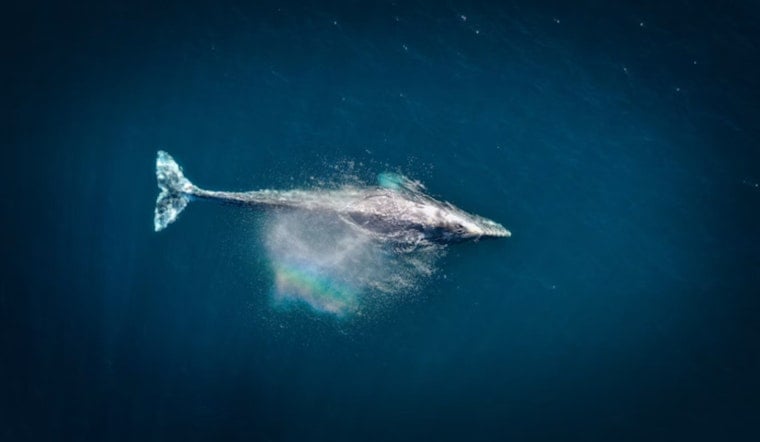
A young humpback whale tangled in fishing gear off Massachusetts got a dramatic second chance on Sunday, after rescue crews rushed out to Stellwagen Bank National Marine Sanctuary and cut it free just ahead of worsening weather. The whale appeared to be pinned in place by rope wrapped tightly around the base of its tail, and rescuers stayed with it until it could move on its own and swim away.
The Provincetown-based Center for Coastal Studies' Marine Animal Entanglement Response (MAER) team answered the call after recreational boaters reported the struggling whale, according to CBS Boston. When the team arrived, they found multiple wraps of rope that had effectively anchored the animal near the surface. Using a hook-shaped knife fixed to the end of a 30-foot pole, they made a series of careful cuts to free the lines. State environmental police and nearby vessels stood by while the MAER team worked, local coverage noted, according to The Inquirer and Mirror.
A responder from the Hawaiian Islands Humpback Whale National Marine Sanctuary joined the operation. "It was an honor to help this whale and great to continue the collaboration between our teams," Maria Harvey said, according to CBS Boston. The Center for Coastal Studies reported that the young humpback carried deep, healing wounds from a previous entanglement, but after the last of the lines came off, responders assessed its overall outlook as good.
Why entanglements keep happening
Entanglements are a persistent and growing threat in U.S. waters. NOAA recorded 95 confirmed large-whale entanglements in 2024 and reports that Massachusetts waters accounted for roughly 18 percent of the cases, with humpbacks the species most often involved, according to NOAA Fisheries. The agency notes that many entangled whales drag line or buoys across long distances, which can make them harder to locate and complicate rescues once teams arrive.
Scientists in the region have been sounding similar alarms. The New England Aquarium recently reported that a young North Atlantic right whale was seen with rope in its mouth in Canadian waters, a stark reminder that whales across the Gulf of Maine system are facing the same hazards, according to the New England Aquarium.
How boaters can help
The Center for Coastal Studies urges boaters who spot an entangled whale to keep their distance, stay with the animal if it is safe and legal to do so, and call in the professionals rather than trying to cut lines themselves. Sightings can be reported to the MAER hotline at 1-800-900-3622 or to the U.S. Coast Guard on VHF 16, per guidance from the Center for Coastal Studies. The program stresses that disentanglement should only be handled by trained, authorized teams, since even well-intentioned attempts can put both people and whales at greater risk. Photos or video taken from a safe distance can help responders identify the gear involved and plan their approach.
The center's Humpback Whale Studies Program is working to identify the rescued animal and will monitor the area for resightings, local reporting said, which will give scientists and responders a chance to document its recovery and check for any lingering injuries, according to The Inquirer and Mirror. Responders credited quick coordination between the MAER team, sanctuary partners and state patrols for pulling off the rescue during a narrow window of time.




